The United States Senate has rejected a resolution aimed at limiting US President Donald Trump’s military action against Iran, dealing a setback to lawmakers seeking to curb the administration’s war powers.
The war powers resolution failed in a procedural vote of 47 to 52, highlighting strong Republican backing for the president’s campaign. A similar measure is expected to be taken up in the United States House of Representatives on Thursday, though it faces significant challenges.
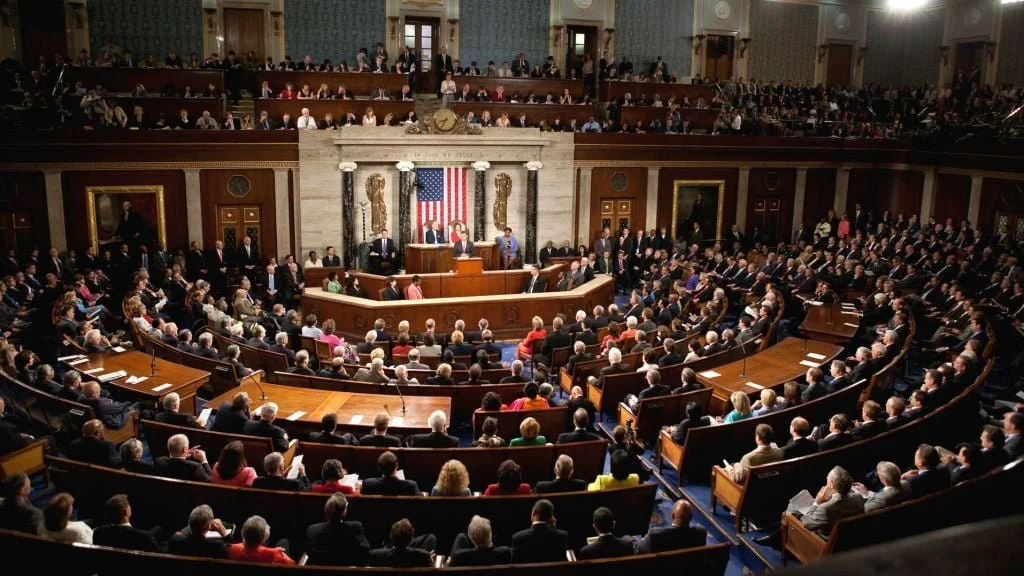
Throughout the day, senators debated Congress’s constitutional authority to authorise or halt military action. Supporters of the resolution argued that Trump exceeded his powers by launching strikes alongside Israel without clear evidence of an imminent threat to the United States.
Speaking on the Senate floor, Senator Tim Kaine said the administration failed to provide proof — even in classified briefings — that Iran posed an immediate danger.
“Even in a classified setting, they could produce no evidence that the US was under an imminent threat of attack from Iran,” Kaine said, rejecting claims that the operation was limited in scope.
Under Article II of the US Constitution, presidents may initiate military action in self-defence in response to an imminent threat. Otherwise, the authority to declare war rests with Congress.
Republicans defend the president
Since launching the offensive on February 28, the administration has offered several justifications for the military action. Trump has claimed Iran was attempting to rebuild its nuclear programme — which he said was “obliterated” in earlier strikes — and develop long-range missiles capable of targeting the US.
Secretary of State Marco Rubio said Israel had been planning to strike Iran, potentially triggering retaliation against US assets in the region. Trump later stated that Iran had been preparing an imminent attack on Israel.
The administration has also characterised Iran’s military and nuclear activities since the 1979 Islamic Revolution as an ongoing threat to US national security.
Several Republican senators argued that decades of hostility from Iran justified the president’s actions. Senator James Risch said the Constitution grants the president both the authority and the duty to protect the country.
“The commander-in-chief ordered this attack because of the increase in the manufacturing of long, medium-range missiles — and after Iran tried to restart the nuclear programme that was decimated in the 12-day war,” Risch said.
He dismissed previous diplomatic negotiations with Iran as ineffective, urging colleagues to oppose the resolution.
The largely party-line vote — with one Republican and one Democrat breaking ranks — marks the latest failed attempt by Congress to rein in Trump’s military actions. Since a June 21 strike, lawmakers have introduced multiple measures seeking to halt operations in Iran and Venezuela, without success.
Under the 1973 War Powers Act, presidents must obtain congressional approval if US troops remain engaged in military operations for more than 60 days.
Earlier on Wednesday, Defense Secretary Pete Hegseth said the US campaign was ongoing, with additional military assets being deployed to the region.
While Trump has suggested the conflict could last four to five weeks, Risch predicted a swift resolution.
“This is going to end, and it’s going to end rapidly. This is not a forever war — not even close,” Risch said.