A monk’s four days in Jaffna, another monk’s restored prison term, and a party visit to Delhi are one argument: trust follows conduct, and the North will not be healed by a file.
The sea, the monk writes, brings us all sorts of things. One slipper arrived five days after the other, and he was wearing the pair. It is a small opening for a large account, and it is the right one. What Ven. Dhammananda Thero brought back from four days at Thapovanam, an ashram beside a lagoon in Allaippiddi, is not a matched set of slogans. It is two things that arrived separately and only make sense together: an extraordinary welcome, and a street that would not smile.
I write this as a Muslim, and I write it as a citizen. I served this country in law enforcement and in intelligence, with the duty of keeping the peace, the security and the sovereignty of the republic. For service in the operational districts I was awarded the Purna Bhumi Padakkama. I do not mention the medal to decorate a paragraph. I mention it so that what follows is not mistaken for a petition from outside the state. The North and East are not a foreign file to me. They are districts in which I served, and people among whom the peace of this country is either kept or lost.
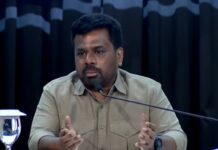
I know the difference between a communiqué and a witness. The piece published by the Walpola Rahula Institute on 20 September 2026 is a witness. From dawn on 22 August until the night of 25 August, a Buddhist monk stayed with Professor Daya Somasundaram, formerly Professor of Psychiatry at the University of Jaffna, in a fishing village the war emptied more than once. He peeled onions. He sat mindfulness with Sinhala, Tamil and Muslim medical students. He chanted the Karaniya Metta Sutta while a former combatant’s lotus seeds went into a pond. On the last day, at Tellippalai, he met faces of unease, dislike and rejection, and was told why. That sequence is what we need today. Not another resolution. The action, and the moral sense, of the prelate.
What he showcased was not Buddhism as a heritage claim. It was Buddha Dhamma as conduct, and ahimsa as a method rather than a motto. He left Wellawatte late on 21 August, reached Jaffna at dawn, and was taken by Mariyadas of Batticaloa, who speaks Sinhala, through Mandaitivu and Kayts. The man who opened the gate, bare-chested, in a short sarong, about seventy-five, was the professor. He sleeps on a concrete terrace under a palmyrah slope too small for a night of rain, eats one meal a day, wakes to yoga, and swims in the lagoon for about two hours each afternoon. None of this is theatre. It is the opposite of possession.
Policy makers should not skip what the place actually does. Allaippiddi was forced out more than once. Many lived in the Vanni before they returned. Almost all the men, the monk was told, are heavily addicted to alcohol. Crystal methamphetamine, the drug our streets call ice, is widespread. Domestic violence is extremely high. Some children do not sleep at home. They go to their grandparents to escape the fighting. Surroundings of that kind teach a child that drunkenness is normal, and that a man who does not beat his wife is weak. In the holidays the children come to Thapovanam for drama, dance, music, drawing, karate, swimming and sand sculpture. The characters are animals. The stories are the real problems of the families. Nothing is aimed at an examination. Each child is fed. On 22 August about fifty came. The monk joined the kitchen and chopped some forty onions for a tomato sambol, beside Mariyadas, his wife Tamil Selvi of Mannar, and women of the village. Selvi’s father supported a separate state, and began each child’s name with the word Tamil. On the evening of 25 August, she still knelt, and so did her husband. No communiqué I have sat through has produced a moment of that weight.
A second classroom answers who a Sri Lankan is more honestly than any clause we have drafted. Dr S. Sivadas, once Somasundaram’s student and now a consultant psychiatrist at Jaffna Teaching Hospital, brought medical students to the ashram — Sinhala, Tamil and Muslim, curious about mindfulness. The next day, at the hospital, the monk guided twenty minutes of anapanasati for first-year students of all three communities. They issued no statement. They breathed in the same room. That is a wider definition than the one announced from Colombo: not a bloodline, not a language, not a monument on a contested coast, but a person willing to sit with the other long enough to become real.
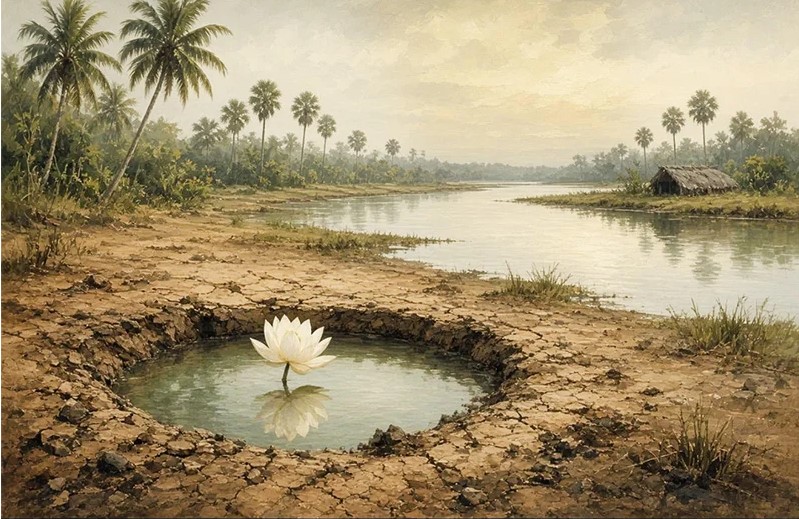
The lotus planting carries the lesson onto scorched ground. The seeds were brought by a former combatant living with post-traumatic stress, who on some nights wakes on the battlefield again. From the bank the monk recited the Karaniya Metta Sutta. He adds what commemorations omit. Former soldiers carry the same nights, known mostly to their families. Ahimsa that cannot see both is not ahimsa.
Then Tellippalai, and the account refuses to flatter us. The town lies about fifteen kilometres from Jaffna, on the road to Kankesanthurai. At midday on 25 August the monk went alone to meet a group of the Chelvanayakam Memorial Trust. At the junction the faces showed unease, dislike and rejection. Not a single smile. Inside, they did not console him. After he left, they said, they too would have to answer the questions people asked. The reason they named was Tissa Raja Maha Vihara, about four kilometres away. Because of that temple, people there have come to see Buddhist monks as persons who arrive to seize land. His sentence belongs in every secretariat and every chapter house. What a terrible misfortune. He asks that it be read by the officers who built the temple, by the monks who live there, and by the lay devotees who travel from Colombo for sil on poya days. The more we try to possess, the more we lose. When we let go, a whole world becomes ours.
The same weeks have given us the opposite conduct, and the country should be made to look at both robes together. Ven. Galagoda Aththe Gnanasara Thero was sentenced in 2018 to an effective six years for contempt of court, over his conduct at the Homagama Magistrate’s Court in 2016 during proceedings on the disappearance of Prageeth Ekneligoda. In May 2019 a presidential pardon released him. On 10 September 2026 the Supreme Court held that pardon unlawful. He did not appear when called on 29 September. An open warrant and a travel ban followed. Police arrested him on 3 October at an aranya in Thiniyawala, Kalutara. Today, 5 October, the Court of Appeal ordered the remaining period of that sentence enforced. A separate warrant had already been issued after he failed to appear in a case concerning an alleged statement insulting Islam.
I am not interested in a further quarrel with the man. I am interested in the robe. The Buddha’s instruction on who may wear it is not obscure. The robe is for a life of restraint, of truthfulness, of harmlessness, and of respect for the discipline that keeps a community from fear. It is not a costume in which to storm a courthouse, to be pardoned out of a sentence, and then to stay away when the highest court restores the sentence. Dhammananda Thero took the night bus to Jaffna, chopped onions, chanted metta over a former fighter’s seeds, and wrote down the street that would not smile. Gnanasara Thero’s recent path was the avoidance of a warrant. One conduct leads human beings towards a peaceful path. The other teaches every community, mine included, to distrust the cloth. Religious leaders who still share a platform with that second example should ask which of the two they are prepared to defend.
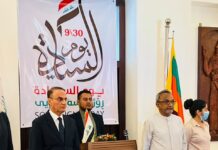
This contrast is not a private matter for the Sangha. It lands in the same week in which the North has again become a diplomatic file. Tilvin Silva, general secretary of the Janatha Vimukthi Peramuna and a powerful figure in the ruling National People’s Power, has just concluded a five-day visit to India, from 27 September to 1 October, at the invitation of the Bharatiya Janata Party under its Know BJP programme. He met senior party figures, among them B. L. Santhosh and the BJP’s national president, and on the last morning he met External Affairs Minister S. Jaishankar, who described India as a trusted partner in Sri Lanka’s progress. The shift is real. The JVP was for years sharply critical of India’s stance on devolution. In 2008 Vijitha Herath, now our foreign minister, called Indian ideas on devolution an indirect support to the LTTE ideology, and said no country had a right to interfere in our problem. New Delhi is now courting the party it once found obstructive.
The hope in Delhi, as set out by those watching the visit, is that JVP leaders can be brought to see devolution not as a stepping stone to separation but as a counter to it, and as necessary to the economic progress of the Northern and Eastern provinces. India has pressed for early Provincial Council elections and for the constitutional provisions that meet Tamil aspirations to be made real. Its interest in the North is not sentimental.
It is geopolitical and practical: connectivity, projects such as the Jaffna airport expansion, a shipping link towards Kankesanthurai, and a stable Tamil-majority littoral that does not become anyone else’s lever. That interest is legitimate for a neighbour. It is not a substitute for our own policy.
The stance of our government is the unfinished half of this story. The party that once treated Indian devolution as a foreign design is now the dominant partner in office, and its general secretary has gone to Delhi as a guest of the ruling party there. Cordiality is not a policy.
Colombo has yet to say, in language a villager in Allaippiddi or Tellippalai can test, whether the North and East are to be governed as equal parts of the republic, with elections and a share of development, or managed as a sensitive file between two capitals. Devolution sold only as an answer to separatism will be heard, in the North, as a security device. Devolution refused because a foreign capital favours it will be heard, in Delhi and in Jaffna, as the old refusal. Neither reading builds the confidence the monk found only when he arrived without a claim.
I say this as an officer who spent his service against separatism in arms, and who does not confuse a provincial council with a separate state. The armed challenge to the sovereignty of this country was defeated. What was not defeated was the inference a street draws from conduct. Tellippalai did not close its face because a constitution was incomplete. It closed its face because a temple was read as seizure. Allaippiddi did not open its kitchen because a delegation had been to Delhi. It opened its kitchen because a monk chopped onions and left. India’s diplomatic approach can support ports, power and elections. It cannot supply the trust. That remains a Sri Lankan task, and it will not be performed by a government that is eloquent in New Delhi and silent on the robe that frightens its own citizens.
The eye-opener is therefore for more than one audience. It is for the Buddhist clergy and laity, who have been shown two paths in the same season and must choose which one the robe will mean. It is for the imam, the priest and the Hindu leader who still announce coexistence and rarely cross the village they have stereotyped. It is for a government that can sit with Jaishankar and has not yet sat, in policy, with the meaning of Tellippalai. And it is for Delhi, which is entitled to its interests and not entitled to mistake a party visit for the healing of a province. Trust is an inference from conduct. People who never enter the room can revoke it.
What is required is a team, in little steps, not a new ministry and not a new patron. Somasundaram has made that team for years. Dr Sivadas carried it into a hospital classroom. Mariyadas and Selvi carried it onto a doorstep. A Muslim leader can take students and stay long enough to work. Trustees of a contested site can say plainly what is worshipped and what is not being taken. A government can enforce a court order without selectivity, and can say what it will and will not devolve without waiting to be asked in Delhi. None of this is a giant leap. Giant leaps here have never been legislated. They are the late result of people who refused, in small rooms, to behave as the stereotype predicted.
The hope is real, and conditional. A lotus pond does not cancel a war, and one cold junction is not the North. The space remains large. It closes where we possess, where a robe is worn against the discipline of the robe, and where the North is discussed over our heads. It opens where someone arrives without a claim. Who a Sri Lankan is will not be settled by a gazette, or by a photograph in New Delhi. It will be settled by whether the next visitor to Tellippalai meets a question or a closed face. Little steps of that nature make the leaps of tomorrow. When we let go, a whole world becomes ours. It was true on a pond bank in Allaippiddi. It remains the only terms on which this island will hold.
( This analysis is offered in the interest of national security, institutional reform, and public safety)
Notes
Dhammananda Thero. (2026, September 20). A lotus pond on scorched earth: A few days of healing at Thapovanam. Walpola Rahula Institute.
Court of Appeal order of 5 October 2026 enforcing the remainder of the sentence on Galagoda Aththe Gnanasara Thero, following the Supreme Court ruling of 10 September 2026 that the pardon of 23 May 2019 was unlawful. Arrest reported on 3 October 2026 at Thiniyawala, Kalutara.
Tilvin Silva led a JVP delegation to India from 27 September to 1 October 2026 at the BJP’s invitation under the Know BJP programme, and met External Affairs Minister S. Jaishankar on 1 October. The reading of New Delhi’s hope on devolution follows M. R. Narayan Swamy, “Why India is wooing Sri Lanka’s JVP,” Rediff, 5 October 2026.
The Purna Bhumi Padakkama was awarded to police and service personnel for qualifying service in designated operational districts between 1977 and 2010.
The writer is a retired Senior Superintendent of Police, former head of the counter terrorism desk at the state intelligence service, a former member of the Sri Lanka Wakfs Board, and the author of Security Beyond Enforcement: Practical Approaches for a Safer Nation (2026).