A convicted monk was brought to the Colombo High Court this week without his robes. The photograph did the rest. Within days the Mahanayaka Theras had written to the Commissioner General of Prisons, a protest had been called, a fundamental-rights petition was before the Supreme Court, and the President had sat down with the Maha Sangha and promised a committee to review the rules within two weeks. Social media supplied the verdict in advance. One side called it an insult to the Dhamma. The other called the outcry a fashion crisis for a felon. Both missed the question that actually matters.
The question is not what a prisoner wears. It is whether religion, politics and the law of the country still occupy separate ground, or whether a single image can collapse all three. That question is older than this government, and the country has answered it badly before.
Ven. Galagodaaththe Gnanasara Thera, General Secretary of the Bodu Bala Sena, is serving the remainder of a six-year sentence for contempt of court, imposed in 2018 after he intimidated Sandya Eknaligoda inside court premises in the case concerning her missing husband, the cartoonist Prageeth Eknaligoda. A presidential pardon granted in 2019 was set aside by the Supreme Court on 10 September 2026 as arbitrary and void. On 6 October he was produced, in a separate matter concerning alleged insult to Islam, in prison-issued clothing rather than saffron.
The Prisons Department says the rule is general. A monk on remand may keep his robes. Simple imprisonment may allow approved personal clothing. Rigorous imprisonment, and production before court of a prisoner serving more than three years, requires clothing issued by the prison. The Commissioner has said the same rule covers the religious figures now serving sentences. The President has said he looked at the cases of the 63 Buddhist monks currently in prison, that other convicted monks have been produced without robes, and that Gnanasara Thera himself wore prison clothing during his earlier imprisonment in 2018.
The Mahanayaka Theras of the Nikayas have not asked that the conviction be undone. Their letter is more careful than the street. They say they respect the Constitution and the judicial process. They say no Sangha Sabha has found a Parajika offence or ordered him out of the Order, and that withdrawal of robes is a matter for the Maha Sangha, not the Prisons Department. They cite Prison Standing Order 550, under which a convicted prisoner taken to court should not be in prison uniform and should be allowed the clothing he normally wore, and they cite the United Nations Standard Minimum Rules for the Treatment of Prisoners. They ask that he wear robes when he is taken out, and that his monastic status be left alone while he serves the sentence. A retired Air Force officer has asked the Supreme Court for an order to that effect. The Sri Lankan Bhikkhu Association in Europe has written in the same direction.
Those are legitimate points of regulation and of religious sensitivity. They are not a claim that saffron is immunity.
Three authorities are being treated as if they were one. They are not.
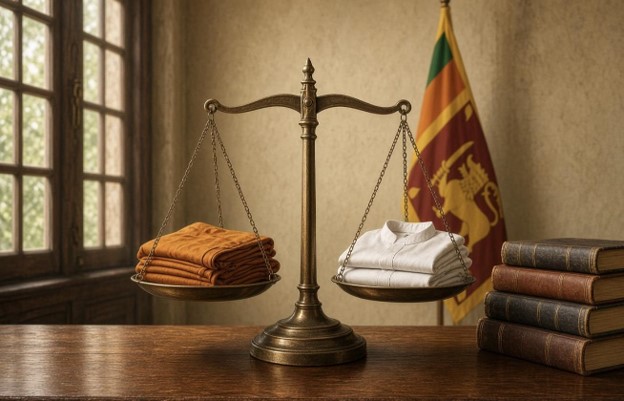
The Vinaya governs the life of a bhikkhu. Whether a conviction under the Penal Code is also a Parajika, and whether robes should be withdrawn, is an ecclesiastical question. The State has no business deciding it. The Sangha has no business deciding the sentence. Criminal law and prison regulation govern every person a court has convicted. A robe is a religious status. It is not a diplomatic passport, and a meeting at the Presidential Secretariat is not a court of appeal. Politics is the third sphere. Its duty is to hold the first two apart, not to borrow authority from either when the street grows loud.
This distinction is not a theory invented for the present argument. It is how Sri Lanka has already treated clergy who fell foul of the criminal law, and the record is worth setting beside this week’s excitement.
On 25 September 1959 Talduwe Somarama Thera shot S. W. R. D. Bandaranaike at Tintagel. The revolver was under the robes. The Prime Minister had risen and greeted him in the customary way. He later described his assailant as a foolish man in robes. The robes were the means of access. They were not a defence. Mapitigama Buddharakkitha Thera, chief incumbent of the Kelaniya Raja Maha Vihara, a political monk and a vice president of the Prime Minister’s own party, was the chief conspirator. His arrest embarrassed the government of the day. Dahanayake had arranged for him to address the nation on Radio Ceylon after the shooting. At the trial Somarama stopped wearing yellow robes in court. Justice T. S. Fernando observed that he had a streak of conscience, because he did not attend court in saffron. He gave up the robes about a fortnight before execution, was baptised in his cell, and was hanged at Welikada on 6 July 1962. Buddharakkitha and H. P. Jayewardena had their death sentences reduced to life by the Court of Criminal Appeal, then commuted to twenty years in 1966 on ministerial advice. Buddharakkitha died in Welikada in 1967, of a heart ailment, after about seven and a half years. No campaign to restore his robes as a condition of imprisonment is part of that record. The political intervention, when it came, was a commutation of sentence. It was not a rewrite of prison dress.
A generation later the accused was a Christian priest, and the result was the same. Father Mathew Peiris, Vicar of St Paul’s, Kynsey Road, an Anglican priest ordained by the Archbishop of Canterbury, was convicted in February 1984 by a three-judge High Court presided over by Justice Tissa Bandaranayake. The court found that he and Dalrene Ingram had murdered his wife, Eunice Peiris, and her husband, Russel Ingram, by the systematic administration of the anti-diabetic drug Euglucon. Both were sentenced to death. The sentences were commuted to life in June 1985. In 1988 the Court of Appeal acquitted Ingram and affirmed his conviction. In 1992 the Supreme Court dismissed his further appeal. He was released in October 1997 under a general amnesty, after roughly twelve to fifteen years, and died at home in Moratuwa in May 1998. Custody was ordinary custody. Chandran Rutnam, who met him at Welikada, later described a long beard, a cross at the neck and a Bible in the hand, but jumper shorts like any other prisoner, not the white cassock. After release Peiris himself described a small cell, locked from evening until morning, common toilets, a diabetic prison diet, and a bed allowed by the authorities. He captained the prison cricket side. There is no record of the Anglican Church, or of any other Church, demanding that the Prisons Ordinance be amended so that a convicted priest could keep clerical dress, or treating the jumper as an attack on Christianity. He remained, in his own mind, a priest. The State remained, in its records, a gaoler. The two facts were allowed to coexist. The useful contrast from our own time is not dress either. It is what religious leadership demanded when religion itself was the scene of the crime.
On 21 April 2019 suicide bombers struck three churches and three Colombo hotels, killing more than 260 worshippers and guests. The attackers died in the blasts. The Catholic Church, led by Cardinal Malcolm Ranjith, did not ask for a special prison regime for the accused. It asked who had failed to act on the intelligence, whether the men in the dock were the whole conspiracy, and whether the State would tell the truth. That demand is still open. In September 2026 the High Court convicted fifteen men and imposed terms running into hundreds of years; nine were acquitted. The Church called the verdict partial. Its pressure was on accountability, not on attire. The other religious reaction to Easter was worse. Communal violence followed, aimed at Muslims who had nothing to do with the bombers. Sermons, robes and political platforms all played a part in that climate. A clergy that can mobilise over a prison photograph, and could not or would not hold the line against collective punishment in 2019, is open to the charge of selective urgency. The charge is fair only if it is made in every direction. Christian leadership after Peiris was quiet on dress and, after Easter, loud on justice. Buddhist leadership in 1959 did not rescue Buddharakkitha from Welikada. Inconsistency, where it exists, is a political fact. It is not a theological one.
What joins 1959 to this week is politics practised in religious dress.
Somarama was admitted to the Prime Minister’s house because he was a monk. Buddharakkitha was useful to a party, and the party was useful to him, until the conspiracy broke. Gnanasara Thera built a public career on the same ambiguity: a religious figure, a political organiser, a man convicted of contempt for intimidating a woman inside a court, later pardoned by a President, the pardon then struck down by the Supreme Court as unlawful.
The robe did the political work. The law, when it arrived, was asked to step around the robe. That pattern is not confined to one Nikaya or one faith. A priest who murders, a monk who conspires to murder, a preacher who incites, a politician who wears religion for a rally, each is using a status the State did not confer and cannot cancel. The State’s only clean response is to ignore the status at the point of arrest, remand, trial and sentence, and to leave ordination to the relevant religious authority.
Remand, conviction and sentence are different legal states, and they have to stay different. A person on remand is not convicted. Current practice, under which a monk on remand may keep his robes, is a rule about the unconvicted. It is not a privilege of religion. Once a court has imposed rigorous imprisonment, the prisoner is a prisoner. Peiris, once convicted, was in a prison jumper. Somarama, once convicted, did not appear in saffron, and the trial judge treated that as conscience rather than as a grievance. The argument now being made, that a Sangha Sabha alone may withdraw robes and that Standing Order 550 preserves pre-conviction clothing on the way to court, can be examined against the regulations and against the Mandela Rules. It is entitled to a hearing. It is not how either of the earlier cases was resolved, and it was not raised by the Christian clergy when one of their own was in the same position.
Equality before the law is the point that must not be lost. It binds the monk, the politician, the officer and the ordinary citizen. It also binds the State in the other direction. If sixty-three monks are in prison under one set of rules, a rule rewritten around one well-known name is not reform. It is an exception. Exceptions made under pressure teach the public that the law is negotiable, and that the negotiation depends on who can mobilise a crowd or a prelate. That lesson is more damaging than any photograph.
The same principle applies to government policy. A rule made for the public cannot be suspended for a constituency. Politicians who act according to the temperature of the week train every future pressure group to manufacture a temperature. The result is uncertainty, then confusion, then loss of confidence, including among the officials who followed the existing rule and now wonder whether compliance will be disowned.
This is where the government’s conduct matters more than the prisoner’s clothing. The President’s public position is the correct instinct. He has said he understands the shock to ordinary Buddhists of seeing a familiar monk in another dress. He has also said he will not set the regulations aside for one individual, that personal preference must not become law, and that prison officials who followed the existing rules are not to be blamed. That is the language of a government that still knows the difference between a grievance and a command. The difficulty is the sequel. A review announced in the middle of protest, with a fortnight’s deadline, and with a promise that provisions affecting monks will be settled with the Maha Sangha, will be read by supporters as responsiveness and by critics as retreat. Both readings are available because the process looks reactive. Law changed to meet an emerging situation, rather than law applied and then reviewed in the open, is how confidence is spent.
What is visible this week is less a doctrinal dispute than a contest of emotions, popularity and opportunity. One side treats the robe as a shield and the photograph as a sacrilege. Another treats the same photograph as proof that piety has been unmasked. Neither is asking the question the country needs answered. Does the existing rule apply equally? Is it sound? If it is to be changed, will the change bind every convicted religious person, of every faith, or only the case that filled the timeline? Religious leadership that frames a regulatory dispute as an attack on the Dhamma invites the same confusion from the other direction. Political actors who ride either emotion are practising an old and expensive habit. The interested party does not have to win the argument. It only has to make the government look as if it governs by concession.
The remedy is dull, and it is the right one. The government should not feed either habit. Publish the regulation relied on, the practice followed since 2018, and the position of the other monks already in custody. Let any committee work against that record, not against a slogan, and let its advice cover a principle rather than a name. If the Standing Orders and the Mandela Rules are in tension, say so, and resolve the tension for every long-sentence prisoner who is taken to court, not for one saffron exception. Yielding to religious or communal pressure in order to quiet a news cycle is cheap politics. So is provoking that pressure in order to look fearless. Maturity is to apply the law as it stands, to change it only by a general rule, and to refuse to let either the robe or the prison jumper become a party instrument.
There is also an intelligence duty in a moment like this, and it is not theatrical. Before the State answers, the ground has to be read. Is the anger spontaneous, the ordinary shock of devotees who have seen a familiar monk in another dress? Is it organised amplification by groups that have waited for a symbol? Or does it sit inside a longer attempt to test whether this government will bend when religion, ethnicity or a mobilised street is placed in front of it? Those are different events. They call for different responses. Conflating them produces either overreaction or appeasement, and both are readable abroad as well as at home. The intelligence community should be tasked to separate immediate sentiment from coordinated mobilisation, and to say so in time for a decision, not after the decision has already been shaped by the loudest version of events. Easter Sunday remains the standing reminder of what happens when warning is available and is not used. A dress controversy is not a bombing. The method of reading it is the same. Find out whether the surge is a mood, a campaign, or part of a larger trial of the State.
Sri Lanka has paid heavily whenever religion was recruited into politics and politics was then allowed to edit the law. The remedy is not contempt for the Sangha, and it is not a special prison regime for the prominent. It is the older distinction, already applied to a conspirator in yellow robes and to a priest in jumper shorts. The Dhamma is not the Penal Code. The Penal Code is not a manifesto. A government that keeps them apart, and applies one rule to every citizen, will be criticised this week. It will be believed the week after.
(This analysis is offered in the interest of national security, institutional reform, and public safety)
The writer is a retired Senior Superintendent of Police, former head of the counter terrorism desk at the state intelligence service, a former member of the Sri Lanka Wakfs Board, and the author of Security Beyond Enforcement: Practical Approaches for a Safer Nation (2026). Email-mahildole54@gmail.com