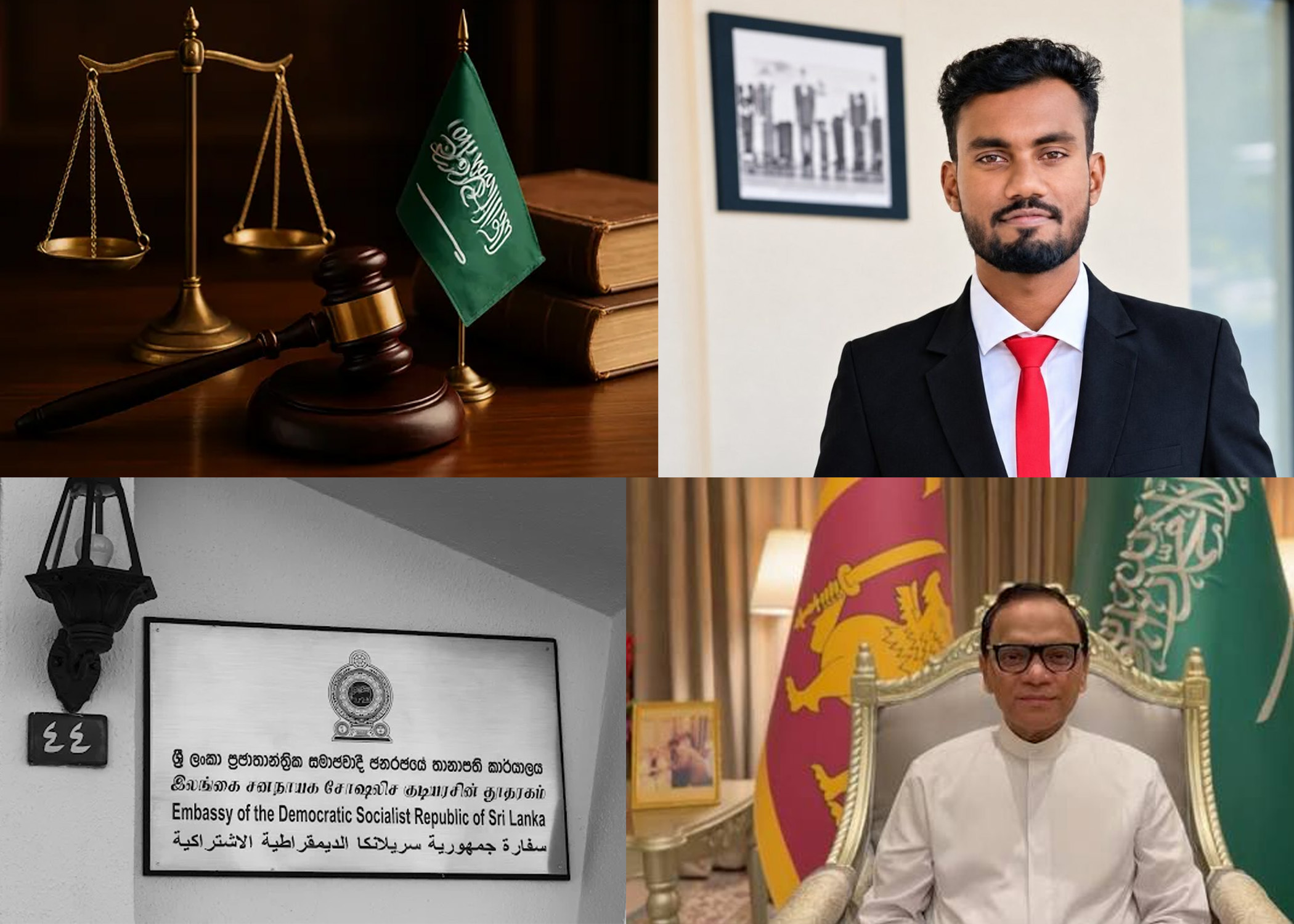
Two months of sustained diplomatic engagement and coordinated legal efforts accompany a landmark judicial development.
In a case that captured national attention and stirred deep concern across Sri Lanka, the decision of the Supreme Court of the Kingdom of Saudi Arabia to overturn the death sentence imposed on Sri Lankan national Sivarasa Anojan brought profound relief to his family and to many Sri Lankans who had followed the proceedings with apprehension.
Behind this significant development was a period of sustained diplomatic engagement by Sri Lanka’s Ambassador to Saudi Arabia, O. L. Ameer Ajwad. His efforts illustrate the role that quiet, patient and carefully calibrated diplomacy can play when a Sri Lankan national faces an exceptionally serious legal predicament abroad.
The development is particularly significant given the gravity of the case, the sensitivity of the judicial proceedings and the intense public interest it generated in Sri Lanka.
For nearly two months, the Embassy of Sri Lanka in Riyadh pursued sustained engagement through official communications, consular interventions, consultations with Saudi legal professionals and coordination with relevant authorities. The objective was to ensure that Anojan’s circumstances received appropriate attention while fully respecting the laws, judicial institutions and sovereignty of the Kingdom of Saudi Arabia.
The Supreme Court’s decision of 13 October 2026 to overturn the death sentence imposed by the Court of Appeal marked a significant turning point in the case. It brought immense relief to Anojan’s family and to many Sri Lankans who had anxiously followed developments.
The decision did not, however, conclude the legal proceedings. The case was remitted for a fresh hearing before a different circuit of the Criminal Court in Al-Ahsa. Continued legal representation and attention to Anojan’s welfare therefore remain essential.
The significance of the Supreme Court’s decision must be understood against the seriousness of the allegations and the consequences Anojan faced under Saudi law. Respect for the laws and judicial institutions of the host country is fundamental to diplomatic engagement. At the same time, protecting the interests and welfare of Sri Lankan nationals overseas is an essential responsibility of the Sri Lankan diplomatic service.
It was within this delicate balance that Ambassador Ameer Ajwad continued his efforts.
The Ambassador’s involvement extended beyond formal correspondence and official representations. In a notable demonstration of personal commitment to his consular responsibilities, he travelled from Riyadh to Dammam Central Prison, more than 400km away from Riyadh, to inquire directly into Anojan’s welfare and circumstances.
During the visit, the Ambassador met Anojan, sought information concerning his condition and engaged with relevant prison officials. He also provided Anojan with his personal mobile telephone number to facilitate direct communication when necessary.
For a detained national facing an uncertain legal process far from home, such personal engagement can carry considerable significance. It demonstrates that consular protection extends beyond diplomatic notes and official meetings to include direct contact, attention to individual welfare and continued engagement with the relevant authorities.
The visit also reflected the Embassy’s responsibility to maintain contact with the detained national and remain attentive to developments affecting his wellbeing.
The Ambassador’s professional background in law and proficiency in Arabic were additional assets in his engagement with the case. These skills supported his ability to communicate effectively, understand the sensitivities involved and engage constructively with relevant interlocutors.
The Anojan Sivarasa case has once again highlighted the importance of effective diplomatic representation in protecting the interests of Sri Lankan nationals overseas.
Diplomacy is often most visible when it produces public agreements, high-level visits or major economic initiatives. Yet some of its most consequential work takes place away from public attention, through persistent communication, carefully managed engagements and sustained efforts to address sensitive issues.
The Supreme Court’s decision has given Anojan’s family and many concerned Sri Lankans reason to breathe more easily after weeks of uncertainty. The development also underscores the importance of allowing judicial processes to proceed while ensuring that the welfare and legitimate interests of Sri Lankan nationals remain a priority for their diplomatic representatives.
The effectiveness of quiet diplomacy is not measured by public statements or personal acclaim. It is reflected in the seriousness with which a national’s predicament is addressed, the professionalism with which institutions engage with one another and the opportunities created for due consideration within the applicable legal framework.
Although the case remains ongoing, the reversal of the death sentence represents a consequential development in a matter of profound concern to Sri Lanka. At a time when the nation had watched with apprehension, this development has renewed hope and demonstrated the importance of patience, perseverance and professional engagement in sensitive consular matters.
It is a reminder that some of the most important work in diplomacy is undertaken quietly, with determination, discretion and an unwavering commitment to the welfare of one’s citizens.
The Anojan case is not the only instance in which the Embassy of Sri Lanka in Riyadh has had to respond to a sensitive matter involving a Sri Lankan national in Saudi Arabia.
Earlier, in May 2026, during the Hajj pilgrimage, Moulavi Nooramith, Secretary-General of the All Ceylon Jamiyyathul Ulama, reportedly faced legal inquiries in the Kingdom. Diplomatic engagement by Ambassador Ameer Ajwad helped facilitate the handling of the matter and his subsequent return.
Although the circumstances of the two cases differ substantially, both illustrate the importance of a measured and professional diplomatic response when a Sri Lankan national encounters difficulties in a foreign country.
The common thread is the responsibility of a diplomatic mission to act diligently, engage constructively with the authorities of the host country and pursue the welfare of Sri Lankan nationals within the framework of the law.
Ultimately, quiet diplomacy is not about seeking recognition. It is about fulfilling a responsibility to the nation and its people, particularly when a citizen faces uncertainty far from home.
Newsnow Sataff