
The Return of an Old Debate
The debate over the Prevention of Terrorism Act and the proposed Protection of the State from Terrorism Bill has exposed a familiar pattern in Sri Lankan politics. As a recent Daily Mirror editorial observed, both the ruling National People’s Power and the main Opposition parties find themselves in awkward positions. The NPP, whose main constituent the Janatha Vimukthi Peramuna long opposed the PTA and suffered heavily under it, has discovered in office that certain investigations appear to require extended detention powers. The Opposition, including parties that either enacted the original PTA or later advanced similar replacement bills, now criticises the new draft. These partisan dilemmas are real. They do not, however, exhaust the problem.
Petitions before the Supreme Court, interventions by the Bar Association and the Human Rights Commission, and wider public unease reflect deeper anxieties. These anxieties rest on prolonged detention, unresolved missing-persons cases, and questions surrounding mass graves. Yet an exclusive focus on the statute, or on which party once supported or opposed it, risks missing the larger issue. Sri Lanka’s cycles of insurgency, terrorism, radicalisation and communal violence grew from structural failures in the political management of diversity, uneven development, and the interaction of domestic grievances with external pressures. Any new law will sit on those foundations. Without change in the practices that enabled violence, suspicion will persist.
How Political Choices Prepared the Ground
The origins of armed conflict were neither sudden nor inevitable. After independence, political competition increasingly organised itself around ethnic and religious identity. Language policy, university admissions, land settlement and public employment became sites of contention. Governments responsive to the Sinhala Buddhist majority introduced measures that many Tamils came to see as exclusionary. Repeated failure to implement negotiated agreements eroded confidence that ordinary politics could deliver fair outcomes. Short-term electoral calculation prevailed over the slower work of building institutions capable of mediating diversity. Some of this was deliberate mobilisation; much was political default. Either way, the ground was prepared for organised militancy.
The Daily Mirror editorial notes that the JVP itself was proscribed and that large numbers of its members and supporters arrested or who surrendered under the PTA never returned. That experience forms part of a wider record in which security laws were applied across communities and political persuasions, often with limited accountability. The same political system that produced those outcomes also generated the grievances on which later armed groups drew.
Economic Neglect and Its Consequences
Economic conditions reinforced the political fractures. The North and East entered the intensified conflict already lagging in infrastructure and opportunity. War destroyed much of what remained. Post-2009 infrastructure projects did not consistently translate into broad livelihood recovery. Youth under-employment and restricted access to land sustained perceptions of marginalisation. These conditions did not automatically produce terrorism, but they preserved grievances that militant organisations could mobilise.
Comparable neglect appeared in other peripheral areas, yet the North-East case was sharpened by active conflict and prolonged militarisation.
External Pressures That Prolonged the Crisis
External actors extended the conflict’s duration. Indian support for certain Tamil groups in the 1980s showed how regional calculations could intersect with domestic insurgency. The LTTE’s diaspora network internationalised funding and advocacy. After 2009, UN Human Rights Council resolutions and trade conditionalities such as GSP+ maintained scrutiny of security laws and accountability. These pressures reflected documented concerns, yet were also shaped by diaspora mobilisation and geopolitics. The Easter Sunday attacks revealed another external vector: local networks drawing on global jihadist ideology. External influences rarely created the core problems; they amplified them.
What Each Community Remembers
Each community retains a distinct memory. Sinhala Buddhists experienced both decisive influence over national policy and prolonged exposure to LTTE attacks on civilians, religious sites and border villages. Many therefore viewed strong counter-terrorism powers as necessary for survival. Post-war, segments of nationalist opinion linked military victory to cultural reassertion; episodic violence against Muslims and occasional pressure on Christians followed. Most Buddhists rejected such acts, yet inconsistent political responses left minorities uncertain.
Muslims faced LTTE expulsion from the North and mosque attacks, then post-2009 majoritarian mobilisation and violence. The Easter attacks, carried out by a small local network, led to widespread PTA arrests. Prolonged detentions where evidence was thin deepened scepticism. Only a fringe adopted stricter imported ideologies, yet the wider community bore the costs. Uneven development in the East supplied further grievances.
Christians experienced the war according to ethnic location and then suffered the concentrated impact of the Easter bombings. Intelligence warnings existed; protective action did not. The community supported firm preventive measures while also demanding accountability for the failures. Civilians across lines became targets when political neglect, weak coordination and extremist networks converged.
The Human Cost Across the Board
In every case the heaviest price was paid by Sri Lankans themselves. Civilians died in bombings and massacres. Police, tri-forces and auxiliary personnel were killed in large numbers. Potential future professionals and local leaders were lost. Where political systems fail to sustain equal citizenship, violence consumes ordinary people and those charged with protecting them.
Security Powers and Judicial Limits
This record explains the ambivalent reception of the present bill. From a security standpoint, ordinary criminal procedure has often proved too slow for networks engaged in planning, financing and radicalisation. The Daily Mirror editorial records that the NPP leadership, once informed by law-enforcement agencies of the practical need for longer detention in cases with international implications, adjusted its earlier position, much as it moderated its stance on the IMF. Intelligence-led detection and pre-emptive capacity remain functionally necessary, as both the LTTE years and Easter demonstrated.
From a judicial perspective, the same record shows the risks of broad definitions, extended administrative detention with limited court control, and powers applied beyond concrete threats. The editorial rightly notes that the new bill exempts protest, advocacy, dissent and industrial action from terrorism offences, an improvement on earlier drafts. Yet it also observes that the practical burden may still fall on the arrested person to establish innocence while detained. Legal frameworks exist to protect the public; when effective judicial oversight is weak, the distinction between protection and intimidation erodes, and confidence declines. Opposition criticism, as the editorial argues, carries limited weight given the UNP’s original enactment of the PTA and the later advancement of similar bills by
UNP-linked and SLPP-supported administrations. Substantive concern about oversight and application nevertheless remains valid regardless of which party raises it.
The Responsibility of Political Authority
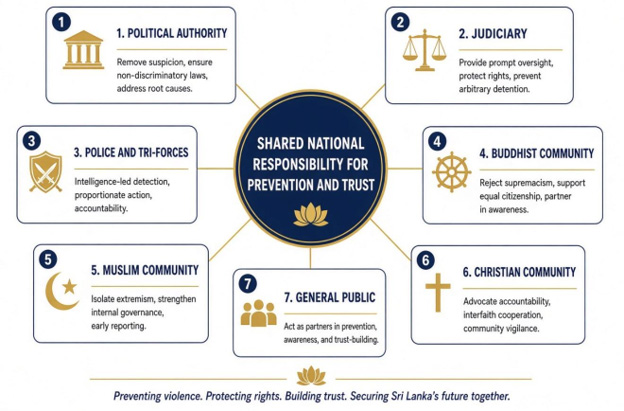
Primary responsibility rests with political authority. Suspicion will not lift through assurance alone. It requires transparent justification of powers, enforceable safeguards, non-discriminatory application, and accountability for misuse. It also requires attention to structural conditions: less reliance on communal mobilisation for electoral gain, more consistent economic inclusion in the North, East and other neglected areas, and clear rejection of both minority extremism and majority supremacism. Security institutions can disrupt threats; they cannot repair the political choices that generated the grievances. The NPP’s discovery in office of the limits of earlier slogans, noted in the Daily Mirror editorial, underscores this point. Assuming power reveals operational necessities; it does not automatically resolve the deeper sources of distrust.
Prevention Needs the Public
Effective prevention depends on sustained public participation and awareness at every level. Communities are frequently the first to detect early signs of radicalisation, unusual behaviour or suspicious activity, signals that formal intelligence systems often receive too late or miss entirely. This information reaches the authorities in time only when citizens trust that institutions will act protectively and proportionately rather than predatory or arbitrarily.
When that trust exists, early reporting and local vigilance become force multipliers: they disrupt plots before they mature, reduce reliance on broad detention powers, and limit the communal backlash that follows successful attacks. When it is absent, prevention weakens, response becomes reactive, and every community pays a higher price in lives lost and suspicions renewed. Public engagement is therefore not a supplementary measure; it is a decisive factor that determines whether security efforts succeed with legitimacy or fail while generating further division.
A Practical Path Forward
The country no longer has the luxury of treating counter-terrorism law as a partisan trophy or a temporary political inconvenience. Legislation that lacks real operational capacity will leave citizens exposed to organised violence. Legislation that lacks prompt judicial control and political restraint will recreate the distrust that has already cost lives and deepened division. Both failures have been demonstrated. Neither can be afforded again.
Political leadership, the present government that has revised long-held positions once in office, and Opposition parties that previously enacted or advanced similar laws, must now move beyond managing their respective dilemmas. The legacy of arbitrary detention, unresolved disappearances and mass graves will not be erased by improved drafting language or by pointing to the other side’s past record. It will be addressed only through consistent practice: precise powers, enforceable oversight, non-discriminatory application, and a deliberate reduction in the communal strategies that originally fed the violence.
Citizens across every community must equally refuse the role of passive spectators. Prevention fails when the public withholds cooperation out of fear, and it fails when any community tolerates extremism in its midst. The evidence of the past four decades is unambiguous: organised violence, whatever its immediate authors or the grievances invoked to justify it, has always extracted its heaviest price from Sri Lankans themselves.
The country already holds these lessons. The open question is whether its political system, beyond the dilemmas of any single bill or electoral cycle, will translate them into institutional practice before another generation bears the same costs. The price of continued deferral has already been paid, repeatedly, by the public. That choice must now end.
(This analysis is offered in the interest of national security, institutional reform, and public safety)
The writer is a retired Senior Superintendent of Police, former head of the counter terrorism desk at the state intelligence service, a former member of the Sri Lanka Wakfs Board, and the author of Security Beyond Enforcement: Practical Approaches for a Safer Nation (2026). Email-mahildole54@gmail.com