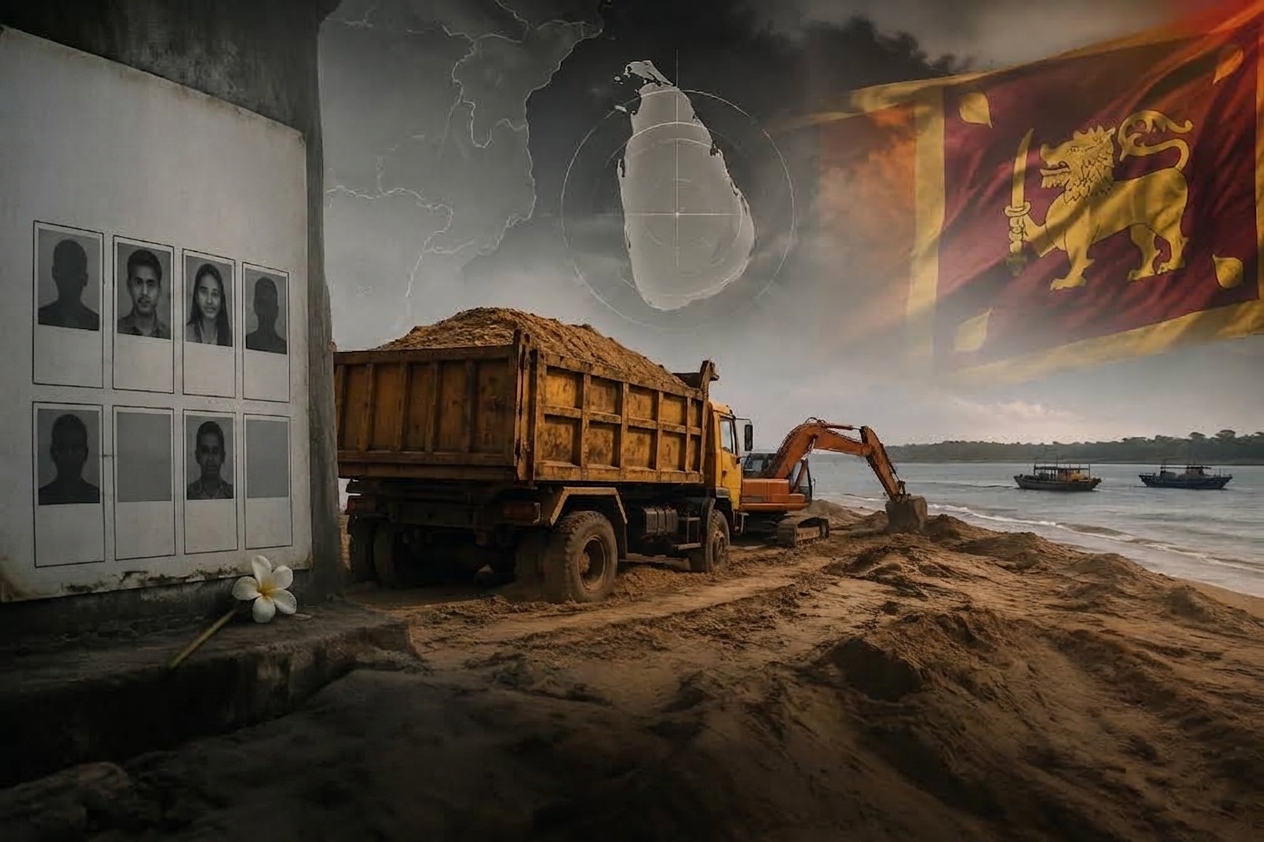
R. Narayan Swamy’s despatch from Jaffna, published on Rediff on 2 September 2026, returns the country to a wound that has never closed. Seventeen years after the war, mothers and wives still march with photographs, still wear the thali in hope, still ask the same question: where are those who were handed over, or taken, and never returned? The grief in that reporting is not invented. Uncertainty of that kind is a form of continuing harm. No serious discussion of national security can treat it as a nuisance to be managed until the cameras leave.
What prompted this column, however, is not only that article. In recent weeks the same Northern and Eastern landscape has been agitated by another dispute that looks, on the surface, unrelated: sand. Illegal river and forest extraction in the Paranthan proposed reserve in Vavuniya; large-scale movement of sand from Mullaitivu, alleged to be leaving the district while local contractors are shut out; the suspension and re-engineering of sand-mining permits in Mannar; protests on Mannar Island and in Poonakary against mineral-sand and limestone extraction, ilmenite projects and associated development that communities say they were not asked to consent to. Foreign licences, domestic rackets, a Presidential Task Force code of conduct, and court and forest-offence files are now running in parallel with the older file of the disappeared.
These are not two separate stories. They occupy the same geography, the same constituency of distrust, and the same international audience. A march for the missing and a march against the removal of the coast are easily fused, in Chennai and in Geneva, into a single claim: that the North-East is still a place from which people and resources are taken, and from which answers do not return. India and Tamil Nadu will not read the Rediff column as a closed chapter of 2009. They will read it beside the Palk Strait, the fishermen’s lock-ups, and the argument over who owns Mannar’s sand. Human-rights organisations and the United Nations Human Rights Council will read it beside Chemmani and a mandate that has just been kept alive. That is the national-security setting in which this discussion has to be held.
That is also why today’s business in Geneva cannot be treated as a side-room affair. According to reports carried in Colombo, the Human Rights Council has adopted, without a vote, a further resolution extending the mandate of the High Commissioner on reconciliation, accountability and human rights in Sri Lanka, and with it the life of the OHCHR Sri Lanka Accountability Project. The sponsors are the United Kingdom, Canada, Malawi, Montenegro, North Macedonia, and a cluster of mainly European co-sponsors. The text does not only speak of 2009. It speaks of mass-grave sites now under excavation, of international standards for exhumation, of the Prevention of Terrorism Act, and of the Online Safety Act. In other words, the disappeared, Chemmani, the statute book and the information space have been packed into one basket. That is not accidental. It is how pressure is organised.
A resolution adopted without a vote is not a compliment. It means the core group judged that a roll-call was unnecessary, or that a fight on the floor would cost more than it would yield. Either reading should concern us. Consensus language of this kind travels easily into briefing notes in New Delhi, London and Ottawa. It will be quoted beside Narayan Swamy’s column and beside photographs from Jaffna. Human Rights Watch, a day earlier, had already called the government’s progress on past abuses tepid and urged the Council not to relax. Non-governmental organisations do not merely document. They time their reports to the calendar of the Council. That is a political method, and it should be answered as one.
None of this requires us to accept every number in the Rediff article, or to concede jurisdiction to an external prosecutor. The figure of 60,000 to 100,000, repeated as if it were a verified 2009 tally, remains an advocacy estimate spanning decades and several conflicts, including the Southern insurgency of 1987–89. The Office on Missing Persons holds a smaller, documented caseload of complaints. The Paranagama Commission recorded around 19,000 missing during the conflict period, including several thousand security-forces personnel listed as missing in action. About 12,000 LTTE cadres were rehabilitated, a fact the article itself notes, and then leaves unused. A focused statistical study of the last three days of the war estimated disappearances in that narrow window in the hundreds, not the tens of thousands. Inflating the figure does not help the families. It hardens positions and makes a workable truth process harder.
Completeness cuts both ways. The LTTE disappeared, assassinated Tamil rivals, conscripted children and expelled Muslims from the North as a matter of policy. The final phase of the war was the collapse of a terrorist proto-state that used civilian density as a shield. Surrenders, last-stand fighting, identity changes, flight abroad and battlefield deaths are still mixed, years later, in the same word: missing. Disappearances were not confined to 2009 or to the North-East. The South lived through 1987–89. That history is not a debating trick. It is relevant because the present government is led by a party that knows, in its own bones, what disappearance did to Sinhalese families. Selective memory on this point weakens the moral claim and hands the argument to those who want a single-community ledger.
India will not read this file as Geneva reads it, and that distinction is the centre of our regional problem. New Delhi is the partner that matters most to this government, first overseas visit after the election, first incoming state guest, defence and energy paper, language that recognises India’s legitimate security interests in the Indian Ocean. It is also the neighbour that cannot ignore Tamil Nadu. The Palk Strait is not a metaphor. Fishermen are still being detained on both sides; harbour associations in Rameswaram still strike; every boat in custody becomes, in Chennai, a Tamil question rather than a maritime one. When mothers of the disappeared march in Jaffna, and when sand and mineral-sand protests rise in Mannar, Mullaitivu and Poonakary, the two images are available to be fused. Tamil Nadu does not need to revive the Liberation Tigers in order to shrink New Delhi’s willingness to spend political capital for Colombo in multilateral rooms. It only needs to show that Tamils in Sri Lanka are still waiting, for the missing, and now for the coast.
China cannot substitute for that relationship. Beijing will blunt some language in larger rooms and finance infrastructure. It will not absorb Tamil Nadu pressure, and over-reliance on China is precisely what makes India more insistent on political deliverables in the North-East. The strategic implication is uncomfortable and clear. India can shield Sri Lanka in multilateral settings only to the extent that Colombo is seen, in New Delhi, as making a serious domestic offer on Tamil political dignity and on the ordinary governance of the former war zone. If Provincial Council elections slip, if land and language remain speeches, and if sand extraction looks like another extraction of the North, every Chemmani photograph becomes a problem that New Delhi must be seen to raise.
Sand is not a small local racket in this setting. Illegal extraction in reserved forest, industrial-scale movement of river sand out of Mullaitivu, the fight over permits in Mannar, and foreign interest in heavy mineral sands, ilmenite and related deposits with industrial and strategic use, sit on the same ground as the wartime file. Communities there already believe that people were taken and not returned. They are now being told that the shoreline itself may be taken under licence. Weak permit histories and the absence of visible local benefit give diaspora networks and international advocates a second, modern grievance to attach to the old one. A state that cannot show that resources in the former conflict areas are governed cleanly will find that “accountability” in Geneva begins to include the geology as well as the graves.
There is a further security layer that polite commentary prefers to skip. Unresolved disappearance is ideal terrain for information operations. Names, photographs, women in black, torch marches and United Nations quotations travel better than the harder facts of rehabilitation, LTTE crime and Southern cases. The file does not need to produce a court judgement next year in order to do strategic work. It only needs to remain open so that every defence partnership, every preference scheme and every review of our statutes can be laced with conditionality. Officers and commanders then live under a permanent external judicial overhang, travel risk, third-country jurisdiction, evidence banks built for a future prosecutor. That is encirclement without a shot being fired. It also damages the institutions we will need again for counter-terrorism, narcotics and organised crime, because a force that is treated only as a suspect class will not take operational risk with a clear head.
A professional response has to do several things at once, and sentiment will not substitute for any of them. First, own the complete ledger. Any Sri Lankan account that cannot name LTTE disappearances, child soldiers, the expulsion of Muslims, Tamil-on-Tamil killings and the Southern insurgency will lose the argument before it starts. Second, make the Office on Missing Persons and the Chemmani excavations forensically unimpeachable. If families and visiting ambassadors can say they do not trust the process, the process has already failed as strategy. International technical assistance on exhumation, DNA and chain of custody can be accepted without accepting international jurisdiction. That distinction is the core diplomatic line and must be held in public, not only in talking points. Third, separate humanitarian closure from criminal theatre. Certificates of absence, pensions, land and support for women-headed households address the daily harm. Cases that can be proved should be prosecuted in our courts. Cases that cannot be proved after seventeen years should not be allowed to become a permanent international indictment of the entire war-termination.
Fourth, settle the sand file as governance and as organised-crime control. Permits, royalties, local employment, environmental standards and the breaking of illegal extraction chains are national-security measures in the North-East, not merely environmental ones. If the state does not govern the resource, others will narrate it as plunder. Fifth, use India as the political buffer, which requires giving India something real: fishermen arrangements that actually reduce arrests; a dated plan for Provincial Councils or an honest public explanation of delay; visible progress on land and language. Without those, Tamil Nadu will monopolise the bilateral relationship. Sixth, treat information as a security function. Fragmented messaging is how external actors write the story. There should be one authorised public record, Office on Missing Persons statistics, rehabilitation numbers, LTTE crimes documented to the same standard as state cases, Southern files, and a single briefing line used by the Foreign Ministry, Defence and the civilian leadership.
The worst case is not a tribunal next month. It is a slow constriction: officers facing third-country legal risk; partnerships carrying political caveats; Tamil Nadu turning every bilateral deliverable into a precondition; North-East youth inheriting a story in which the Sri Lankan state is only a perpetrator; a government elected on system change discovering that Geneva does not reset because the presidency changed. The better case is narrower and less theatrical. Families receive answers that can be stood behind. India continues to absorb multilateral weather. The military is not collectively indicted. The LTTE’s own record sits on the same page as the state’s. Sand and mineral-sand extraction in the former war zone is seen to be clean, local and lawful. That outcome requires political courage inside Sri Lanka, not another resolution.
Narayan Swamy has written the human paragraph that we are obliged to answer. The sand disputes of these past weeks have written the second paragraph. Geneva, today, has written the third. The national-security question is whether Colombo treats them as three irritants or as one campaign that has already moved from Mullivaikkal to Chemmani, from the graves to the shoreline, and from Jaffna to the Human Rights Council and into Tamil Nadu’s harbour politics. Those are no longer separate files. If we do not define them as a complete national accounting, of war, of crime, of resources and of the neighbourhood, others will continue to define them for us.
The writer is a former Deputy Director of the Counter Terrorism Desk, State Intelligence Service, and a former member of the Sri Lanka Wakfs Board. Views are personal.