By Riza Yehiya (Senior Architecture)
Sri Lanka’s recurring communal disputes are rarely about the immediate issue alone. A disagreement over a uniform, a language, a land boundary or an administrative decision can quickly become a contest over identity, power and belonging. The deeper question is whether the state can accommodate profound diversity without allowing that diversity to fracture the nation.
The recent dispute at Kalmunai North Base Hospital is a revealing example. Nine Muslim women appointed as Junior Health Assistants were reportedly prevented from reporting for duty because of their religious attire. The women were wearing the prescribed uniform together with a headscarf and modest long-sleeved clothing. Hospital authorities referred to uniform regulations, while the women’s representatives cited Public Administration Circular No. 13/2019(I), which permits public officers to wear additional attire consistent with religious requirements, provided the full-face remains uncovered.
On the surface, this is a dispute about workplace rules. In Kalmunai, however, such a dispute cannot be separated entirely from the area’s complicated history of Tamil-Muslim political competition, contested representation and demands over administrative power and resources. Kalmunai is predominantly Muslim, with a substantial Tamil population, and questions of identity and political authority have long been sensitive there.
That is precisely why the response must be larger than the immediate controversy. Sri Lanka needs a way of thinking about pluralism that avoids two equally dangerous extremes: forcing everyone into an artificial uniformity or allowing every difference to become a basis for political separation.
I call this approach asymmetrical synergy.
Diversity without fragmentation
The phrase may sound abstract, but the principle is straightforward.
Asymmetry means recognizing that different communities and regions do not have identical histories, circumstances or needs. Treating citizens equally under the law is indispensable, but identical treatment in every circumstance does not necessarily produce substantive fairness. Reasonable accommodation may sometimes be required so that equal citizenship becomes meaningful.
Synergy means that recognition of difference must be accompanied by structures of cooperation. Asymmetry without synergy can produce fragmentation. Synergy without asymmetry can become assimilation.
The objective, therefore, is neither uniformity nor separation. It is differentiated accommodation within one sovereign state, combined with equal citizenship and a shared constitutional framework.
This distinction matters greatly for Sri Lanka. A Tamil community in the north and east, a Muslim community in the east, a Sinhalese community in the south and the smaller communities scattered across the island may have different historical experiences and contemporary concerns. A fisherman in the North, a farmer in the South and a trader in the East do not necessarily encounter the same problems. A government that insists on a one-size-fits-all model may satisfy the appearance of equality while failing to address genuine differences.
Yet asymmetry must never become a license for communal domination, ethnic segregation or competing sovereignties. It should not mean separate states, unlimited communal vetoes or the abandonment of common national institutions.
It should mean something more constructive: different communities can receive the accommodation they legitimately require while remaining participants in one national project.
Sri Lanka cannot simply be governed as if it were a compact city-state run entirely from the centre. It is a country of regions, languages, religions, memories and identities that extend deep into history.
The task is therefore to build a state strong enough to accommodate diversity, rather than a state that regards diversity itself as a weakness.
The Kalmunai test
The government has already taken a sensible first step by bringing Muslim and Tamil parliamentarians into discussions and indicating that both immediate and permanent solutions are being considered.
The immediate objective should be simple: the nine women should be allowed to assume their appointments, through a practical temporary arrangement, if necessary, while the underlying regulatory question is resolved. Hospital administrators, trade unions, Muslim representatives, Tamil representatives and the relevant authorities should be brought into a structured dialogue.
The government should avoid declaring communal winners and losers. The issue should be resolved through law, evidence and administrative reason.
That does not mean ignoring legitimate institutional concerns. Hospitals have genuine requirements concerning professional dress, hygiene, identification and safety. But those requirements should be applied consistently and proportionately. Where existing public-service rules already allow reasonable religious accommodation, administrative practice should not contradict them through arbitrary interpretation.
The lesson should therefore be broader than the immediate dispute: public institutions need clear rules for religious and cultural accommodation, and officials need authoritative guidance on how those rules should be applied.
Ambiguity is dangerous in a plural society. It invites inconsistent decisions, encourages political intervention and allows routine administrative disputes to become communal confrontations.
A permanent review mechanism for disputes involving religious or cultural accommodation would help prevent that escalation.
Equality must include reasonable accommodation
Sri Lanka’s constitutional and civic order must begin with equal citizenship. No citizen should receive fewer rights because of ethnicity, religion or language.
But equality does not require the state to pretend that every citizen lives under identical circumstances.
There is an important distinction between equality and reasonable accommodation. Equality establishes the same fundamental rights and obligations. Accommodation recognizes that legitimate differences sometimes need to be addressed so that those rights can actually be exercised.
A Muslim woman wearing a headscarf does not cease to be a public servant. A Tamil citizen does not become less Sri Lankan because of language or historical memory. A Sinhalese citizen should not be expected to surrender cultural identity in order to demonstrate national loyalty.
The state should therefore establish common professional standards while allowing reasonable religious and cultural accommodation wherever this does not compromise legitimate public interests.
This is not preferential treatment. It is what mature pluralism looks like.
From crisis management to institutional reform
The hospital dispute should be used as an opportunity to examine the wider public service.
Recruitment, promotion, disciplinary procedures and administrative practices should be reviewed to ensure that they do not inadvertently discriminate against any community. Representation in decision-making institutions also matters. A state cannot easily claim to understand a plural society if significant communities are consistently absent from the rooms where decisions are made.
But representation should not become another form of communal arithmetic. The goal is not to divide every institution into ethnic quotas. It is to build institutions in which citizens from different communities can participate confidently and where competence, integrity and fairness remain fundamental.
This is where asymmetrical synergy becomes practical. The state can maintain common standards while adapting particular arrangements to local circumstances.
The same principle can apply beyond the public service. Regional development, education, language services, land administration, policing and economic policy can all be designed with sensitivity to local realities without weakening national sovereignty.
Reconciliation cannot be postponed
No institutional reform will succeed permanently if the historical grievances that shape communal distrust remain unresolved.
Sri Lanka’s communities have different memories of the conflict. For Tamils, the war includes experiences of militarization, displacement and land loss. Muslims carry their own memories of violence, displacement and massacres, including the killings associated with Kurukkalmadam and Veeramunai. Sinhalese communities, too, experienced death, insecurity, economic disruption and the psychological burden of a war that divided the country.
Recognizing this does not require competing claims about who suffered most.
Indeed, reconciliation becomes impossible when victimhood itself becomes a competition.
Sri Lanka needs a credible, domestically led truth, justice and reconciliation process involving truth-telling, reparations and restorative justice, drawing where appropriate on international experience. The proposed participation of judicial experts, legal scholars and religious elders could help give such a process legitimacy.
Mutual recognition of suffering is essential. Investigations into massacres and mass graves, including renewed attention to Kurukkalmadam and Veeramunai, must ultimately lead to credible truth and accountability rather than merely renewed public controversy.
Reconciliation must also deal with material grievances. Land, displacement, demilitarization, housing and the rights of Malaiyaha Tamils cannot be treated as secondary questions. Nor should reconciliation be confined to the three largest communities. A genuinely plural Sri Lanka must include its smaller communities, whose identities can easily disappear within majoritarian politics.
The missing ingredient: economic interdependence
Political reconciliation will remain fragile if communities have little practical reason to depend on one another.
Economic interdependence can turn the idea of synergy into something tangible.
The North, East, South and central regions should be encouraged to develop economic partnerships that cross communal boundaries: fisheries cooperation, agricultural value chains, tourism, regional infrastructure, small and medium enterprises, youth employment and joint investment.
A Tamil entrepreneur, Muslim trader and Sinhalese producer should be able to see their prosperity as connected rather than competing.
When communities share markets, businesses, infrastructure and economic opportunities, communal confrontation becomes more costly. Shared prosperity can create a practical foundation for shared citizenship.
This is the economic meaning of synergy: people do not merely tolerate one another; they have a stake in one another’s success.
A state that is neutral, not passive
The state must also reclaim its role as a neutral arbiter.
Neutrality does not mean standing aside when discrimination occurs. A neutral state actively protects the rights of every citizen and applies to the law impartially.
Police, courts and the civil service must be protected from political interference. The rule of law must operate equally across communities. Officials who engage in discriminatory conduct should face appropriate accountability. Otherwise, inclusivity remains a slogan rather than a governing principle.
The public must be able to believe that an administrative dispute will be resolved administratively, not according to the political strength of the community involved.
That trust is the foundation of the state.
Resist the politics of division
There is another danger: domestic communal disputes can be exploited by political actors or external interests.
Disinformation can magnify relatively contained incidents into national crises. Political entrepreneurs can convert legitimate grievances into electoral mobilization. External actors can sometimes find advantage in societies divided against themselves.
Sri Lanka therefore needs greater transparency in political and foreign funding, stronger enforcement against hate speech and incitement, responsible media reporting, and civic education that helps citizens understand how ethnic divisions can be manipulated.
But the cure must not become another source of repression. Transparency and national security should not be used as excuses to silence legitimate dissent, civil society or minority political representation.
Rather than banning ethnic-based political parties outright, Sri Lanka should create stronger incentives for multi-ethnic political participation. Electoral and institutional reforms could reward parties that demonstrate genuine cross-community support, while laws against incitement and communal hatred should be enforced firmly.
The objective should be to make cooperation politically rewarding and polarisation politically costly.
A practical three-stage programme
The principle of asymmetrical synergy should not remain a theoretical proposition.
First, immediate action. Resolve the Kalmunai dispute, allow the affected employees to take up their posts, clarify the applicable regulations and establish a mechanism for resolving similar disputes.
Second, institutional action. Review public-service rules, strengthen representation and accountability, develop clear procedures for religious and cultural accommodation, and depoliticize public institutions.
Third, national action. Advance reconciliation, address land and other material grievances, encourage inter-community economic partnerships and reform political incentives so that national leadership depends on cooperation across communities.
Each stage reinforces the next. Crisis management without institutional reform merely postpones the next crisis. Institutional reform without reconciliation leaves historical distrust intact. Reconciliation without economic opportunity risks becoming symbolic.
The three must therefore proceed together.
The choice before Sri Lanka
The Kalmunai dispute should not be allowed to become another chapter in Sri Lanka’s history of communal escalation.
It can instead become a test of whether the country has learned something fundamental: diversity does not have to be the enemy of national unity.
The alternative to majoritarianism is not fragmentation. The alternative to fragmentation is not forced uniformity.
Sri Lanka needs a stronger idea of unity—one that is confident enough to accommodate difference.
That is the purpose of asymmetrical synergy. It recognizes that communities have distinct histories and legitimate needs, while insisting that they share one state, one civic future and a common responsibility for the country’s prosperity.
It requires immediate de-escalation, clear and inclusive rules, accountable institutions, meaningful reconciliation, economic interdependence and a state that acts as a neutral protector of all citizens.
Above all, it requires trust.
The state must demonstrate that it belongs to its people—not to one ethnicity, one religion or one political camp. Communities must likewise recognize that their security cannot ultimately be built by weakening the security of others.
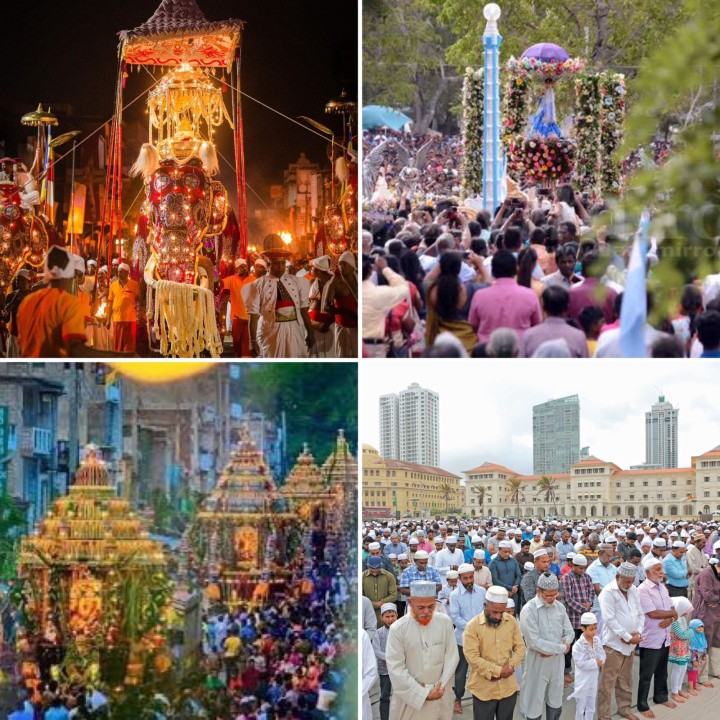
Sri Lanka’s beautiful diversity is not a problem waiting to be solved. The problem is the political and institutional failure to turn that diversity into a source of strength.
The country therefore faces a choice. It can continue allowing every difference to become a battlefield, or it can build institutions that transform difference into cooperation.
The latter will require political courage, constitutional imagination and a refusal to exploit communal anxieties for short-term gain.
A united Sri Lanka does not have to be a uniform Sri Lanka.
It can be a country in which different communities remain recognizably themselves while sharing institutions, prosperity, rights and responsibilities.
That is the promise of asymmetrical synergy.
And there must be one clear rule above all others: no political or geopolitical adventure should be permitted to exploit Sri Lanka’s ethnic and religious diversity.