Sri Lanka Police has just marked 160 years. The parades were in order. The sentence that should have followed them has not been written with enough force. A police service that is pulled by politics, rewarded for individual glory and tried every night on social media cannot protect a country that is now a maritime hinge for international narcotics and financial crime. The political authority must decide, not in a speech, but in conduct, whether this force belongs to the law or to the loudest faction of the week.
That is not a plea. It is a warning.
The political hierarchy and the police hierarchy now agree that the service needs a new outlook, beginning with the uniform. The cut and the kit are not yet settled. That conversation is overdue. Criminals have moved into containers, encrypted apps and international logistics. An officer equipped for a quieter decade is less able to detect, and less able to come home.
Sophistication of kit is essential. Body-worn cameras, communications and protective equipment that match the threat are not luxuries. They keep a policeman alive.
If the first decision of this compact is only what the officer will wear, the wrapping will be modern and the person untouched. The priority is not a new silhouette. It is a different person inside the uniform.
The officer is a human being
He and she is a product of this complicated society. The fractures that run through the village, the school and the social-media feed run through the recruit. Communal suspicion, religious identity and ethnic memory are not checked at the armoury gate. The question treated as delicate is operational: is this officer mentally geared for ordinary crime and for communal, religious and ethnic conflict?
What is his stand if he belongs to one community and is sent into a dispute involving another? How will the parties look at him? How will the media frame the first photograph? That decides whether a crowd sees the law or “the other side.” We are all Sri Lankans. The sentence is easy on a Police Day banner. It is hard at a junction when rumour is already ahead of the patrol.
Every officer, from constable to gazetted rank, must be trained for these issues as deliberately as for a baton. Not one lecture at Katukurunda: recurring, scenario-based work on mixed neighbourhoods, mixed complainants, and keeping personal faith out of the method of work. The media will hunt the communal angle; parties to a conflict will hunt the ethnic one. The only answer that holds is an officer whose first identity on duty is Sri Lankan and whose first loyalty is the law.
That is “We.” Assuming the uniform dissolves identity is how a single incident becomes a national story.
What they have been is not what they can remain
From the 1866 ordinance this service has been the state’s civilian arm, colonial order-keeping, post-independence law and order, then a wartime partner that buried its dead beside the armed forces. Specialised units were built for terrorism, organised crime and financial intelligence. The same institution was used as a residual army, a political instrument and a promotion marketplace. Loyalty too often attached to a person, not to the law. Easter Sunday made the price visible. So did every file that moved, or stalled, according to who was in office.
A history of sacrifice does not excuse a present of capture. It makes the capture more shameful.
What they are today
On paper the force is large, some 79,000 authorised, 609 stations. On the ground it is thin. More than 4,300 officers have left since 2020. Vacancies exceed 30,000. Shifts of twelve to eighteen hours are still treated as normal. Distress is still logged as discipline rather than welfare. That is waste, not toughness.
Crime has two faces, and both strike national security. Gang violence over narcotics still produces shootings. Sri Lanka also sits on feeder routes moving Afghan and Pakistani product toward other markets. Harbour and high-sea detections in the hundreds of kilograms are no longer rare. Ice hidden in towels at Colombo Port; heroin pulled from multi-day trawlers; scam compounds and frozen assets in the billions of rupees, these are not “ordinary crime.” They buy influence and fund the next consignment.
The third battlefield is information. Reels and anonymous accounts impersonate officers, launder rumour as fact, and reward the man who seeks a following. Inside the service the culture still teaches “I”: my file, my photograph, my briefing. Rank is being treated as a prize. It is a trust.
The container that became a campaign
Late August 2026, officers opened containers at the Colombo International Container Terminal and recovered some 463 to 472 kilograms of crystal methamphetamine, concealed in towels, originating from Pakistan and valued in the billions of rupees. Suspects including foreign nationals were arrested. The United States DEA publicly associated itself with the intelligence. The criminal case sits with the Central Crime Investigation Bureau.
That is a success. It should have been protected as a success.
Instead, an internal process review, ordered by the Inspector General into how information moved between bureaux, was translated on social media into another story: that the IGP and Senior DIG Ranmal Kodituwakku were being “chambered” over the detection. An Opposition MP warned, correctly, that putting the officers who delivered the raid under a public microscope will teach the service the wrong lesson.
State the distinction without apology. A criminal file is about the network and the money. A process file is about timelines and chain of custody. A blog is neither. Collapsing a Senior DIG’s recorded statement into “the hierarchy is in the dock” is not accountability. It is a gift to those who packed the towels. After a half-tonne interdiction, a process review is normal; leaking it as a morality play is not. Complete the inquiry on the record. If negligence is found, deal with it. If not, say so. Half-spoken files let rumour colonise the institution.
Training, technology and a mind that can bear the load
The IGP and the hierarchy must stop treating training as a calendar ornament. Immediate programmes are required, not next year’s paper.
First
, the evolving issues: communal and religious tension, narrative operations, child and women protection, financial and cyber crime, harbour interdiction, the law of arrest.
Second
, the technologies: digital evidence, data protection under the Personal Data Protection Act, disciplined open-source work, body-worn cameras that protect the public and officers alike.
Third
, mental health as operational infrastructure, counselling an Inspector can use without becoming a Legal Division case, and early recognition of burnout before it becomes a headline.
Incentives must follow: allowances for certified competencies, promotion credit for courses applied, not for attendance photographs. Asking for sophistication at the port with no path to acquire it is theatre.
A new uniform that can carry a camera, worn by an officer unprepared for the society he polices, is a costume. The station, the cell, the unseen hour Look next at where this officer lives and works. Many stations are old, congested and unhygienic. Living standards on duty are low. You cannot demand a different person in the uniform and house him as if he were expendable.
Cells are a particular failure of command. Too many sit out of sight of the men on duty. They are dilapidated. What happens inside goes unnoticed until a death, an assault or an escape. That is a design of our own buildings, not a secret of the underworld. A cell that cannot be seen cannot be defended in court or in conscience. Refurbish, fix sightlines, monitor what the Constitution requires, and treat an escape as a failure of supervision before it becomes a press note.
These are not welfare extras. They are the conditions under which evidence is kept, suspects are held, and officers decide whether the job is still worth the family cost.
The health of the officer is the health of the public
One of the first duties of the hierarchy is the health of the policeman and his family. A sick officer with a sick child is not “uncommitted.” He is a risk to himself, to the next raid, and to the citizen at the counter. Police hospitals are few. Officers in rural stations cannot reach them in time. The IGP should not wait for a building programme. Speak to the health authorities now. Arrange priority access for officers and their families at government hospitals. Dedicated wards or reserved beds are not a privilege class. They are the minimum owed to people sent into harm, and into other people’s crises, at every hour.
Good health is a good mind. A good mind is good care for the people. No uniform compensates for an officer who has not slept, has not been treated, and cannot reach a Police hospital.
What they must be tomorrow
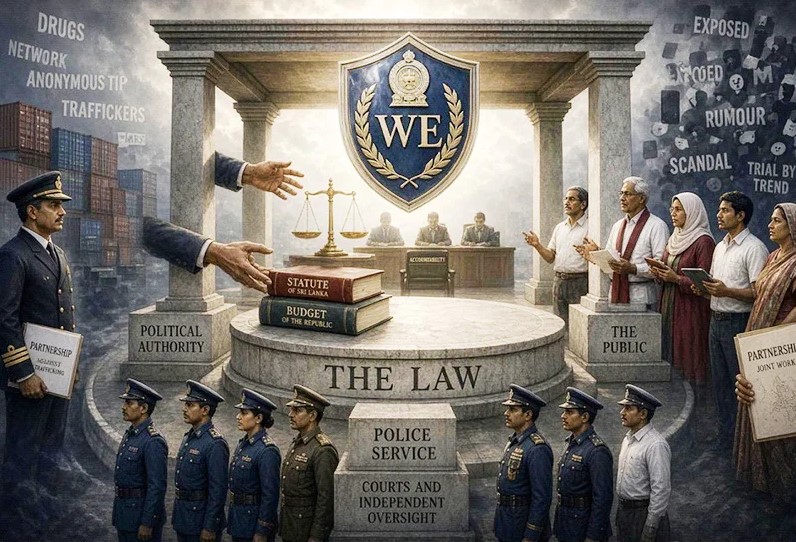
The country does not need more decoration. It needs a service the public can approach without fear and that no politician can casually redirect: intelligence-led against networks that threaten the state; digitally capable and legally bounded; trained for communal heat as well as narcotics; housed and treated as human beings; collectively minded. We hold the ground, not I cleared the file.
The constable at the junction and the analyst tracing a hawala chain are the same institution. National security is not a specialist’s private property.
To the policymakers and the political authority
You have agreed with the Police hierarchy on a new outlook. Use it for more than cloth.
Independence is not the IGP’s personal autonomy. It is the institution’s ability to apply the law without fear or favour, and still answer to the law. You cannot have that and also have a Police summoned, transferred or publicly undermined according to the needs of the week.
Appointment and removal of the Inspector General must remain a process, not patronage. The National Police Commission must exercise its powers over promotions, transfers and discipline without being hectored from the gallery. Cabinet sets policy and budget. It does not choose Tuesday’s suspect. Comment from the House on the guilt of named officers while a file is open is not oversight. It is interference under another name.
If you want an apolitical Police, stop using internal inquiry as a factional weapon and social media as a substitute bench. Different treatment of files is the old disease. Naming it only when the officer is someone you dislike is the same disease.
Then fund what a new uniform implies: immediate training, habitable stations, cells that can be seen, and a health arrangement with the Ministry of Health that does not leave a rural sergeant’s family outside the gate. Announcing kit and withholding living conditions is not reform. It is dressing the service for a photograph.
The public has a part. Distinguish error from crime. Cooperate with the officer who is fair; demand consequences where he is not. In conflict, look at the uniform as the law, not as a census of name, faith or village. Do not outsource judgement to an anonymous account.
The stand It is not I. It should be We.
A new uniform will not make an officer Sri Lankan. Training, health, housing, an apolitical file, and a command that treats him as a human being might. A service that thinks in individual glory will be outrun by networks that think in systems. A political class that thinks in capture will keep receiving detections and wondering why the pipeline never closes. A country that argues about the cloth while the person inside it is exhausted, untrained for communal fire, and unseen in a dilapidated cell block is not preparing for tomorrow. It is rearranging the wardrobe.
The law cannot serve two masters. Neither can the uniform, old or new.
(This analysis is offered in the interest of national security, institutional reform, and public safety)
Mahil Dole, SSP (Retd.), served as Deputy Director in charge of the Counter-Terrorism Desk of the State Intelligence Service and later as Intelligence Coordinator to the Inspector General of Police. He is a former Member of the Sri Lanka Wakfs Board and author of Security Beyond Enforcement: Practical Approaches for a Safer Nation. Email – mahildole54@gmail.com