Sri Lanka stands at a familiar and dangerous juncture. A procedural controversy has once again been converted into a contest over identity, loyalty and political advantage. Social media has accelerated the distortion, political actors are calculating the returns, and ordinary citizens are left to absorb the tension. The question is no longer whether the country can afford another cycle of manufactured division. The present generation has already answered that it cannot. What remains is whether those who hold religious and political authority will act on that answer.
Enough is enough. Sri Lanka has already endured ethnic and communal conflicts of the most serious kind, some of which drew direct or indirect foreign attention and intervention. The present generation, which lives with the economic and social consequences of those years, has no desire to repeat them. Large numbers of citizens now recognise that the most destructive episodes were not inevitable accidents. They were produced, in significant measure, by design, by political policies that were biased and opportunistic, and that treated identity as a reliable instrument for gaining or retaining power. Certain ideologies supplied language and justification, but the decisive factor was the calculation that division delivered electoral and patronage returns. The ultimate victims were ordinary people.
The Cost of Design and the Role of Religious Leadership
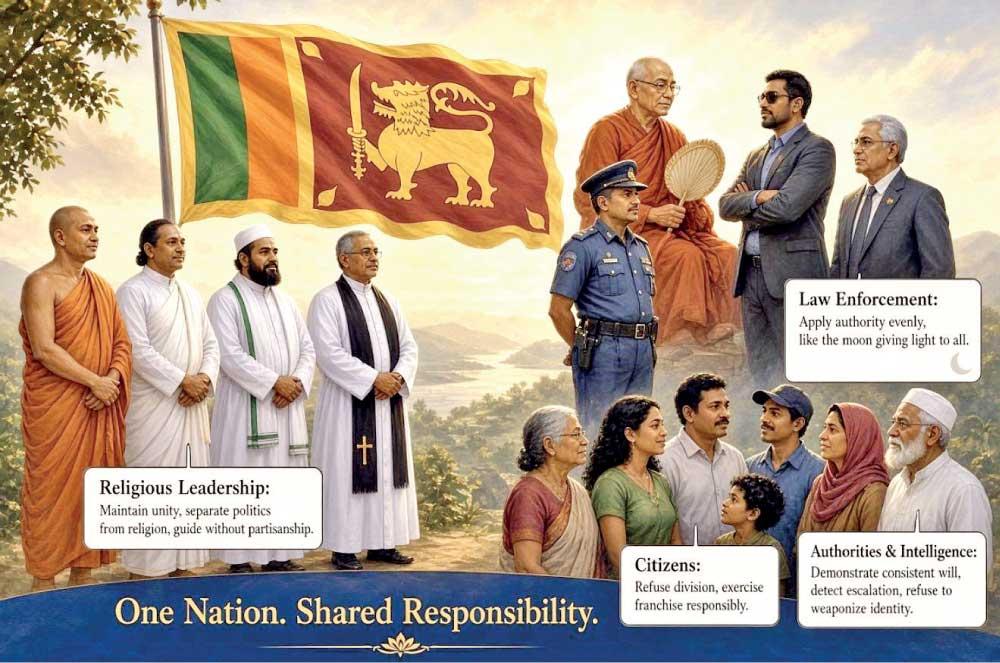
That recognition places a clear responsibility on the religious leadership of the country. In a multi-ethnic, multicultural and multi-religious society whose ordinary life once sustained a workable mixed culture of tolerance, Buddhist, Hindu, Muslim and Christian clergy have historically been among the few institutions able to counsel patience and to remind communities of interests that cross political lines. That role formed part of the practical architecture of social stability and national security. When religious authority is drawn into partisan contest, or when its standing is reduced by the perception that it has become an extension of political machinery, the country loses one of its remaining restraints. The people pay the price.
The controversy that has produced the march and the intense social-media traffic around the robes is the latest illustration. A question of prison administration, the equal application of rules to a person in custody, has been rapidly converted into a public test of loyalty to Buddhism and to the majority community. Selective images and inflammatory framing have circulated faster than careful accounts of the legal issues involved. Political actors have assessed how far the resulting emotion can be stretched. In mixed workplaces and neighbourhoods, people measure their words. Younger citizens encounter simplified narratives that reduce religious teaching to slogans of defence and grievance. Minority communities watch the tone and the official response with the memory of earlier crises.
Recognition, Dignity and Risk of Mobilisation
Dinesh Dodamgoda, writing in the Colombo Telegraph, supplies a precise account of the mechanism at work. Drawing on Francis Fukuyama’s reading of the Greek concept of thymos, the desire for recognition and dignity. He distinguishes isothymia (the wish to be treated as equal) from megalothymia (the wish to be recognised as superior or specially protected). In his analysis, the removal of the robes is experienced by many Sinhala Buddhists not simply as the uniform application of prison rules but as a public slight to a sacred symbol of identity. That reaction, he notes, can be mobilised by traditional political forces promising restoration of precedence, and it can shape electoral behaviour more powerfully than economic indicators alone. The clash is between a politics that insists on equal treatment under the law and a politics organised around the recovery of perceived lost status. Dodamgoda’s point is not that cultural sensitivity is illegitimate. It is that the emotional response becomes dangerous precisely when it is converted into an instrument for electoral mobilisation.
Sri Lanka’s Constitution already accords Buddhism the foremost place and imposes on the State the duty to protect and foster the Buddha Sasana while guaranteeing the rights of other religions. That dual obligation does not require the transformation of every administrative decision involving a member of the clergy into an existential struggle, nor does it entitle any political force to treat the emotional reaction as a campaign resource. When sections of the religious leadership allow themselves to be positioned as protagonists in that struggle, they narrow their own future capacity to urge restraint. They also supply those who wish to portray religion itself as the source of the country’s difficulties with additional material. The distinction between protecting religious practice and weaponising it is the condition for religious voices to retain credibility across communities.
Distinct Callings and Demand for Political Will
The same distinction must be insisted upon with politicians. Politics and religion each have legitimate spheres. One concerns the organisation of power, the allocation of resources and the enforcement of law under universal franchise. The other concerns moral teaching, ritual life and the formation of conscience. When the two prey upon each other, when clerical authority is lent to campaign mobilisation, or when political actors invoke religious sentiment to evade accountability, the boundary collapses, and the public suffers. Religious leaders are uniquely placed to state this boundary clearly and to decline invitations to cross it. Their refusal would not constitute withdrawal from national life. It would constitute the exercise of the responsibility that has historically made their counsel valuable: the maintenance of unity and peace by refusing to let either be subordinated to short-term political advantage.
Authorities in power can make this distinction a practical reality only if they demonstrate consistent, visible will rather than episodic statements. Confidence among stakeholders does not arise from rhetoric. It arises from predictable conduct under pressure. Early, plain-language explanation of administrative and legal decisions, before narratives harden, reduces the space for organised amplification. In the present case, this means stating clearly why prison rules were applied as they were, what the constitutional duty toward the Buddha Sasana requires, and why equal treatment is not hostility to Buddhism. Transparent consultation with senior figures from the Maha Sangha and from other faiths, conducted without electoral timing, would signal that the State values religious counsel on cohesion while refusing to subcontract political choices to it. Selective engagement that rewards the loudest voices undermines confidence on all sides.
Even Application of Authority and Institutional Boundaries
Law-enforcement agencies and the intelligence community have corresponding duties. Officers are required to apply authority evenly, without regard to status or political utility. In 1986, while serving as Officer-in-Charge of the Wanduramba police area, I regularly sought the assistance and counsel of Buddhist prelates, including the late Ven. Waihene Kassapa, Chief High Priest of Galapatha Purana Rajamaha Viharaya, Wanduramba, and Chief Judicial Sangha Nayake of the Southern Province. Although I am a Muslim, I received consistent guidance grounded in principle rather than partisanship. These prelates did not align themselves with politicians; they regarded the law-enforcement authorities as the institution to be supported and protected in the maintenance of order. It was from Ven. Waihene Kassapa that I received the clear exposition of the Buddha’s teaching that the Dhamma should be like the moon in the sky. Giving light alike to everyone, without distinction between rich and poor, and the direct advice that a police officer must enforce authority in the same impartial manner. That counsel has remained a practical standard.
Intelligence services are responsible for identifying when symbolic or procedural disputes are being deliberately organised and amplified by actors who benefit from instability. They have seen the pattern before: identity grievances used as low-cost instruments to discredit institutions or to create conditions favourable to particular political returns. Early warning and the disruption of coordinated disinformation are legitimate tasks. Managing the public narrative is not. That remains the obligation of elected leaders and of religious figures who still accept that their standing depends on independence from partisan calculation.
Visible professionalism in policing and intelligence work reassures citizens that public order is not being managed for political effect. When these institutions are perceived as instruments rather than as professional bodies, acceptance of difficult decisions declines across communities. The hardest test for the authorities remains the refusal of short-term electoral calculations that treat identity mobilisation as a usable resource. Historical patterns show that the returns to division have often exceeded the returns to restraint. A sustained demonstration of will would include declining to amplify grievance narratives, declining to remain silent when others do so, and measuring success by reduced communal temperature rather than by temporary mobilisation.
Shared Symbols and the choice before the
present generation
Symbols of shared identity continue to exist. National sports teams drawn from different ethnic and religious backgrounds compete under one leadership, and the raising of the national flag still produces an emotional response that crosses community lines. These demonstrate that the capacity for collective identification has not disappeared. It has been repeatedly damaged by policies that rewarded division. Restoring the conditions in which that capacity can operate does not require the denial of constitutional recognition or of cultural sensitivity. It requires the consistent refusal, by those who hold religious and political authority, to treat either as a weapon.
The present generation has already concluded that the most serious ethnic conflicts were produced more by design than by default. That conclusion creates an opening and carries a demand. Religious leadership must use its remaining authority to make politicians understand that politics and religion are distinct callings, each diminished when it captures the other. Law enforcement must continue to apply rules without fear or favour. Intelligence services must track those who seek to escalate tension for advantage. Authorities in power must supply the early explanation, even application of rules, insulation of religious authority from partisan use, and refusal to reward division that alone can convert stated intentions into stakeholder confidence. Citizens must decline to reward, at the ballot box, the repeated conversion of identity into an instrument of power.
Conclusion
Religions and religious communities should serve as resources for national security, social cohesion and development, not as instruments of insecurity and division. When led responsibly and kept independent of partisan politics, their moral authority reinforces patience, mutual respect and a shared sense of belonging. When subordinated to the pursuit of power or converted into vehicles for grievance, the same institutions become sources of instability. Sri Lanka’s future depends on religious leadership and the State alike ensuring that faith strengthens the rule of law and national resilience rather than undermining them. Only then can religious communities fulfil their proper role as pillars of security and progress instead of instruments of destruction.
Enough has already been expended on that conversion. The victims have always been the same: the people of this nation. The decision to stop supplying further victims lies with those who still possess the standing to insist on the difference between protecting faith and weaponising it, between governing and mobilising grievance. If that difference is not enforced now, the country will once again discover that the cost is paid not by those who design the conflict, but by those who must live with its consequences.
(This analysis is offered in the interest of national security, institutional reform, and public safety)
The writer is a retired Senior Superintendent of Police, former head of the counter-terrorism desk at the state intelligence service, a former member of the Sri Lanka Wakfs Board, and the author of Security Beyond Enforcement: Practical Approaches for a Safer Nation (2026). Email-mahildole54@gmail.com