A sessions court in Gandhinagar, Gujarat, India, has sentenced three men to rigorous life imprisonment in a cow slaughter case, citing passages from Hindu scriptures, including the Manusmriti and the Vedas, in its judgment.
In the opening four pages of the judgment, delivered on Monday, the court discussed the religious and cultural significance of cows before examining the merits of the case.
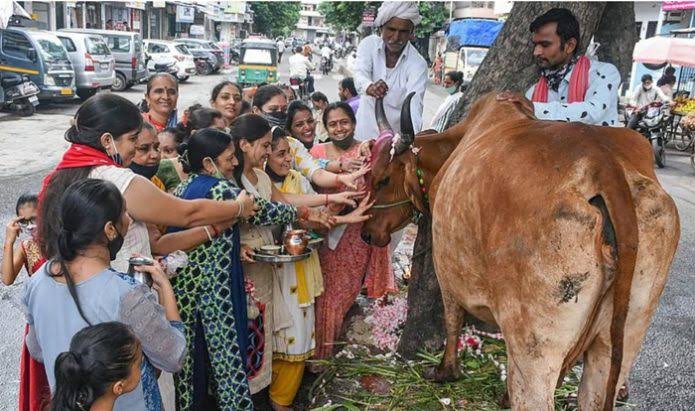
The judgment referred to ancient texts that regard cows as sacred and describe them as mothers of the universe, with 33 crore deities believed to reside in them.
The court said the accused had slaughtered cows and attempted to sell their meat despite being aware of the cultural and religious significance attached to the animals.
Additional Sessions Judge B. R. Rajput convicted the three accused, identified as Wasim Kureshi, Mohammed Rafiq Kureshi and Asfak Bahelim, all residents of Ahmedabad.
According to the case, the accused purchased old or non-milking cows and buffaloes at low prices before slaughtering them for commercial purposes.
They were found guilty under the Gujarat Animal Preservation (Amendment) Act and the Prevention of Cruelty to Animals Act, among other charges.
While imposing rigorous life imprisonment, the court observed that the accused had slaughtered the animals and dismembered their bodies despite knowing the importance attributed to cows in Hindu tradition.
The judgment stated that police had caught the accused in the act and seized approximately 277 kilograms of beef while they were making arrangements to sell it.
The court further observed that failure to impose the punishment prescribed by law in such cases could eventually lead to the extinction of cows.
In its reasoning, the court cited the Manusmriti, stating that the text recognises the cow as more than an ordinary animal and associates it with the principles of dharma.
The judgment also referred to the traditional classification of social duties in Hindu texts, stating that Maharishi Manu assigned the Vaishya varna the responsibility of protecting cows.
It further described cows as the mothers of cattle on earth, underscoring their religious and cultural significance in Hindu tradition.
The ruling highlights the role of religious and cultural references in the court’s reasoning in the case, alongside the relevant animal preservation and cruelty prevention laws.