
The Challenge of Blurred Boundaries
For thousands of years, belief in a reality greater than ourselves has shaped cultures, offered meaning beyond the fragility of human life, and supplied rituals, ethical codes and forms of healing that give order to communities. Religions have helped societies articulate shared values and, at their best, have restrained power and encouraged mutual obligation. In Sri Lanka these traditions, Buddhist, Hindu, Muslim and Christian, have long been part of everyday life and have coexisted within a plural social order.
The difficulty arises when the boundaries between religion, politics and law are allowed to blur. Faith is then pressed into service as a political instrument, and the law is applied unevenly according to communal calculations rather than uniform principles. Grey areas, spaces of ambiguity where religious authority, political interest and legal enforcement overlap, create room for selective interpretation, rumour and mobilisation. The result is not greater moral clarity but heightened suspicion and openings for those who thrive on division. Sri Lanka’s recent experience illustrates the cost.
Communal tensions that once remained largely contained have, in places, hardened. The Easter Sunday attacks of 2019 showed how local fractures can be exploited by external ideologies with lethal consequences for lives, trust and national stability. Since then, overt calm has largely returned, yet inter-community suspicions and intra-community divisions persist. Both create space for opportunistic actors to generate instability that directly affects security institutions, economic confidence and social resilience.
The Need of the Day
The need of the day is therefore twofold: a deliberate effort to remove these grey areas by keeping religion, politics and law in their proper spheres, and a sustained, practical interfaith dialogue that reduces the raw material of suspicion. Religion belongs to the domain of conscience, moral teaching and voluntary association. Politics is the arena of contestation over public policy; it must operate under rules that treat citizens as equal before the state. Law is the impartial instrument that protects rights and punishes crime without regard to the faith or ethnicity of the parties. When these domains remain distinct, religious life can continue to contribute positively to social order. When they are mixed, security becomes harder to maintain.
Practical Steps to Remove Grey Areas and Strengthen Dialogue
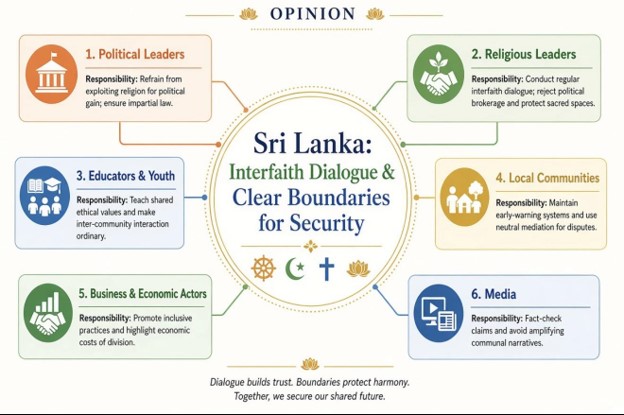
Political Restraint and Impartial Application of the Law
Political parties and candidates should adopt and publicise a minimum code of conduct that prohibits the use of religious or ethnic grievance as a campaign tool. This need not be new legislation; it can be an agreement monitored by an independent body drawn from retired judges, senior civil servants and representatives of the major faith communities. Public reporting of violations raises the political cost of such tactics. At the same time, state institutions must demonstrate even-handed application of existing laws. Timely investigation and prosecution of violence or incitement, regardless of the community involved, removes the perception that the law itself has become a political instrument. Transparency in the handling of sensitive incidents further reduces space for rumour and the grey areas in which distrust grows.
Religious Leadership and Regular Interfaith Dialogue
Religious leadership can reinforce the boundary from its own side while actively expanding interfaith dialogue. Leaders retain moral authority precisely when they decline to act as political brokers. Structured interfaith platforms that already exist should meet on a fixed, regular schedule rather than only in moments of crisis. These gatherings can address practical matters: joint condemnation of violence, coordinated responses to natural disasters or public-health emergencies, shared guidelines on the conduct of preachers, and the management of places of worship so that sacred spaces are not used for political mobilisation. Within each tradition, internal discipline is equally important. Clear standards that discourage inflammatory speech reduce the material available to external manipulators. Bodies such as the Wakfs Board have experience in promoting order and interfaith engagement; similar voluntary standards can be developed across communities without state dictation of doctrine. Regular dialogue of this kind does not require theological agreement; it requires the willingness to remove ambiguity about what is acceptable public conduct.
Education and Youth Engagement
Education offers a longer-term corrective. School and university curricula can present the ethical teachings and histories of Sri Lanka’s religious traditions side by side, emphasising shared concerns for justice, restraint and care for the vulnerable. Practical programmes, joint service projects, inter-school activities or media-literacy modules that train students to identify divisive content, make interaction ordinary. Youth organisations and sports bodies can expand mixed activities so that difference is experienced as normal rather than exceptional. These measures equip young citizens to resist narratives that treat religion as a zero-sum political identity and thereby shrink the grey areas in which suspicion thrives.
Local Communities and Economic Actors
Local and economic actors can embed clearer boundaries in daily practice. Neighbourhood and place-of-worship committees can maintain informal early-warning arrangements and agree in advance on neutral mediators for disputes. When incidents occur, mediation by respected local figures who are not identified with any political party often resolves matters before they escalate. Business associations and chambers of commerce, which already operate across communal lines, can adopt simple inclusive standards in hiring and community investment and publicise the economic costs of instability. Visible interdependence, shared markets, supply chains or tourism ventures, demonstrates that division carries material consequences for everyone and reduces the space for political actors to exploit religious differences.
Media and Digital Responsibility
Media and digital platforms share responsibility for not amplifying unverified communal claims. Professional associations of journalists can maintain rapid fact-checking partnerships with academic or interfaith bodies. Consistent application of existing professional standards helps prevent the rapid spread of narratives that widen grey areas between fact, faith and political interest.
These steps rest on institutions and relationships that already exist. Their effectiveness depends on consistency: political actors refraining from exploitation, religious leaders protecting the integrity of their teachings through dialogue rather than political brokerage, and the law remaining visibly impartial.
Conclusion
In Sri Lanka today the most immediate requirement is sustained interfaith dialogue that removes the grey areas in which religion, politics and law have been allowed to overlap. The country does not lack moral resources or institutional experience. What it lacks is the consistent practice of keeping the three domains distinct while using religious platforms for practical cooperation rather than episodic statements. The Easter Sunday attacks exposed how quickly local suspicions and external influences can converge when trust is thin and boundaries are unclear. The persistence of inter- and intra-community divisions since then shows that the underlying conditions have not fully disappeared. Left unaddressed, these conditions continue to offer openings for those who benefit from instability, whether for political advantage or more destructive ends.
Interfaith dialogue that is regular, practical and insulated from electoral calculation can shrink those openings. When leaders of different traditions meet not only after an incident but as a matter of routine, when they jointly clarify acceptable conduct and reject the political use of sacred spaces, and when political authorities and law-enforcement agencies demonstrate that the law applies equally, the grey areas narrow. Young people who encounter difference as ordinary, and local communities that resolve disputes through neutral mediation, further reduce the raw material of suspicion. None of this requires any community to surrender its faith or its legitimate interests. It requires only that difference not be converted into a permanent political asset or a selective legal liability.
Sri Lanka’s security and stability ultimately depend on the willingness of its citizens to live under common rules while retaining the moral resources their religious traditions provide. Those traditions have historically emphasised restraint, justice and responsibility toward others. Preserving that contribution in the present climate demands deliberate effort to keep faith distinct from political contest and legal enforcement, and to replace ambiguity with regular, practical dialogue. The country’s plural society has weathered severe tests before. It can continue to do so if political authorities, religious leadership, educators, local communities and economic actors treat the removal of grey areas and the practice of interfaith dialogue as the practical necessity of the day rather than an occasional aspiration. The security of every community, and the stability of the nation, depends on that choice. (Source World Religions – Michael D. Coogan and 6 others)
(This analysis is offered in the interest of national security, institutional reform, and public safety)
The writer is a retired Senior Superintendent of Police, former head of the counter terrorism desk at the state intelligence service, a former member of the Sri Lanka Wakfs Board, and the author of Security Beyond Enforcement: Practical Approaches for a Safer Nation (2026). Email-mahildole54@gmail.com