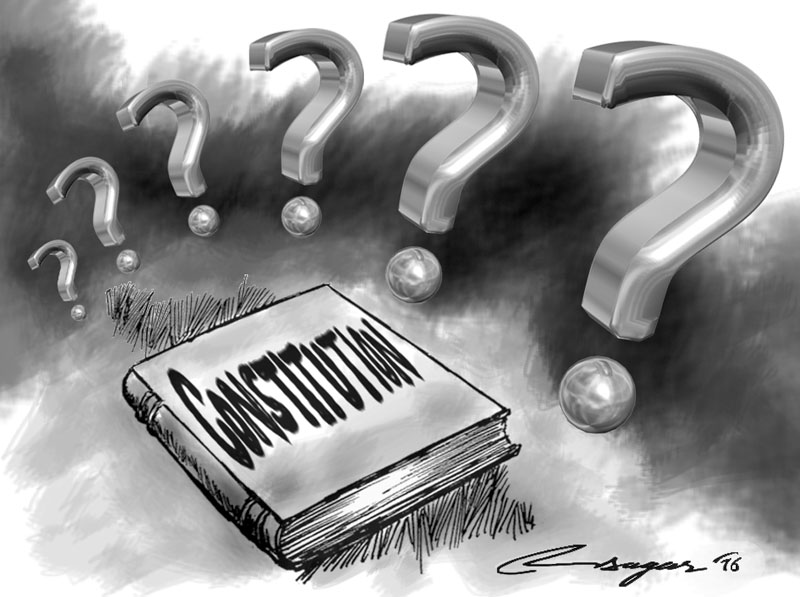
There is a beautiful Sinhala proverb: “ගින්නෙන් දැවුණු නිවසක පුළුන් ගෝනියක් ඉතිරි වේද?” (Can a bag of cotton survive in a burning house?). Today, a section of Sri Lankan society has become highly vocal. Not about the judges themselves, but about the possibility of extending their tenure through a new constitutional amendment, referred to as the 22nd Amendment. From opposition political parties to the Bar Association of Sri Lanka (BASL), and the Commonwealth Lawyers Association (CLA) alongside its regional counterparts, many are busy issuing statements and pledging to fight until the very end. Meanwhile, the Government enjoys a comfortable silence. Or perhaps it is simply waiting for the stars to align.
Yet, despite all this noise, the ordinary citizen remains largely silent and detached. The streets are not filled with public anger. Daily life goes on as usual. People are more worried about whether the war around the Strait of Hormuz will escalate. After all, even a single moment of disruption there can send the price of a liter of petrol soaring here.
Constitutional memory is short
Sri Lankans understand this country has already witnessed moments when the foundations of its constitutional democracy were seriously undermined. Maybe they understand that every constitutional fire does not begin with visible flames. Sometimes, it begins with a small spark that many choose to ignore. The ordinary citizen knows something that the Bar Association of Sri Lanka, and even the self-proclaimed guardians of democracy, have forgotten. The question is not merely whether the bag of cotton inside the burning house can survive. The bigger question is this: Who set the house on fire in the first place?
Throughout Sri Lanka’s recent history, many of those who now speak loudly about protecting the democratic palace were present when different parts of that same palace were slowly exposed to fire. The unceremonious removal of former Chief Justice Shirani Bandaranayake and the 51-day Constitutional Coup are two such moments that we should recall with heavy hearts.
Every political science student is familiar with the phrase “aggregation of interests.” It is a classic concept of liberal democracy. It means gathering the views and interests of different sections of society before turning them into public policy. Those groups include political parties, pressure groups, civil society organisations, and other like-minded supporters. Today, social media personalities and YouTube influencers have also become active participants in this process.
NPP’s struggle between liberal promises and ideological roots
The National People’s Power (NPP) followed this exact formula during both the presidential and parliamentary election campaigns. To give this process a liberal democratic flavour, it invited many influential groups to gather around the Compass, the party’s election symbol. Prime Minister Harini Amarasuriya became the strongest symbol of this approach. She was the human face of the NPP’s strategy of aggregating interests. But now the NPP is in power. Listening to different groups during an election campaign is one thing. Governing is another. While the NPP embraced the language of liberal democracy to mobilise support, the ideological roots of the JVP have traditionally been different. They are more closely associated with Marxist political thought, where the management of competing interests takes place under the leadership of the political party rather than through continuous bargaining among competing groups.
Many of today’s constitutional and political controversies emerge from this tension. The NPP mobilised voters using the language of liberal democracy, yet it now appears to be governing through political principles that many Sri Lankans are still trying to understand. This is the struggle of centrism. Ironically, Marxism has often viewed centrism as an opportunistic political position. That is exactly what makes the current political drama fascinating. There are some things that are difficult to get rid of. The unfinished dreams of rulers are a key matter. In Sri Lanka, many rulers seem to believe that introducing a constitutional amendment is something they can do overnight. Perhaps they have never heard what Dr. B. R. Ambedkar, the principal architect of the Indian Constitution, once said:
“Constitution is not a mere lawyer’s document. It is a vehicle of life, and its spirit is always the spirit of the age.”
A wrong constitutional amendment can weaken a state for decades. Former Executive Presidents Mahinda Rajapaksa and Maithripala Sirisena tried it. Now it is AKD’s turn. The Bible tells us the story of Jesus turning water into wine at the wedding in Cana. It was His first public miracle. But constitutional governance does not work that way. A ruler cannot simply turn the basic principles of a constitution upside down in the name of the sovereignty of the people.
AKD’s first real constitutional test
In modern democratic governance, a people’s mandate is not automatically stretched to cover everything a Government wishes to do during its five-year term. Although a Government enjoys constitutional authority, that authority is tested every time it seeks to alter the rules of the game. The Government’s attempt to extend the retirement terms of judges whether in the superior courts alone or across the entire judiciary should be defeated before it ever reaches the floor of the Tenth Parliament. But it should not be defeated simply because the Bar Association of Sri Lanka says so, or because constitutional expert-turned-politician Government. Gamini Lakshman Peiris argues against it. Neither can genuinely claim to represent the ordinary citizen. Nor do they stand on particularly strong moral ground.
History has taught us to look closely at these sudden bursts of moral outrage. The BASL, after all, operates on a very predictable internal radar: their passionate defense of public justice usually triggers only when the reigning BASL chairperson happens to be on bad terms with the head of state and the ruling inner circle. When the corporate lunches align, however, the day-to-day misery of the ordinary litigant miraculously slips their minds. As for our legislators, they historically treat constitutional engineering the way toddlers treat Lego blocks—building things up only to smash them down when they get bored. Consider the illustrious track record of Government. Prof G L Peiris. Once hailed as a towering constitutional pandith, he raised his hand in absolute support of both the 18th Amendment and the 19th Amendment. To vote “yes” on both pieces of legislation requires a truly spectacular level of flexible logic; their core motives were as different as the sky and the earth. One concentrated absolute power, and the other claimed to dilute it.
When the self-proclaimed champions of the law are this beautifully inconsistent, they forfeit the right to claim they stand on the moral high ground. For the average Sri Lankan, access to the judicial system itself remains an expensive dream. Whether a case is heard by a Supreme Court judge or a Court of Appeal judge does little to ease the burden carried by the common citizen. Yet, we still oppose this move by AKD and the NPP. Not because of the theater being performed by the legal elite, but because of the foundational principle behind it. More than two centuries ago, John Adams offered the clearest answer: “A Government of laws, and not of men.”
Observing the past 661 days of AKD and the 602 days of the NPP’s political trajectory, their primary approach to governance appears to be a silent game, swimming smoothly with the waves rather than fighting against them. This floated idea of extending the term limits of judges may simply be another calculated move in that very strategy, one that AKD will likely quiet down or give up if the resistance grows too loud.
However, withdrawing this proposal will not magically cleanse our judicial system. It remains deeply flawed and badly in need of reform. James Madison settled this debate long ago: “If men were angels, no Government would be necessary.” Constitutions are written for ordinary rulers, not angels. AKD, too, is bound by that simple truth.
The writer is a researcher, elections analyst and civil society advocate specialising in democratic reform and electoral processes. He is the Executive Director of the Institute for Democratic Reforms and Electoral Studies
——————–
The views and opinions expressed in this column are those of the author, and do not necessarily reflect those of this publication