

The military defeat of the LTTE in 2009 was a genuine national achievement. It was earned through sustained intelligence effort, inter-agency coordination, political resolve, and heavy sacrifice. Yet in the years that followed, a quiet complacency took hold. We slept on our laurels. While the State consolidated the conventional victory, residual adversarial networks and political rivalries continued working to their own agendas, prolonging unresolved issues, internationalising grievances, and searching for points of leverage. The security establishment that had demonstrated high capability gradually lost the institutional sharpness that victory had required.
It is necessary to acknowledge historical realities without exaggeration. The adversary’s intelligence apparatus succeeded in assassinating one President, multiple prominent ministers, and attempted the lives of another President and the Commander of the Army. These were not accidental successes. They reflected patient penetration and operational discipline. Parallel questions remain about the handling of communal violence in Aluthgama, Digana-Kandy, Ampara and other locations. Were these failures of collection, failures of timely communication and escalation, negligence, or something closer to deliberate inaction? Incomplete answers left institutional gaps that later events would widen.
Easter Sunday as Turning Point, Not Sole Origin
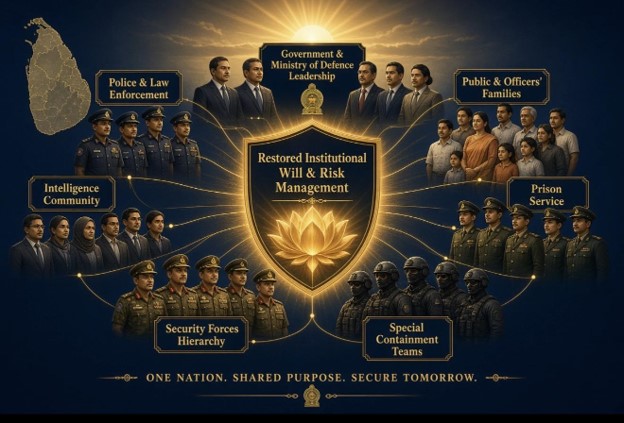
The Easter Sunday attacks of 2019 were a catastrophic failure. They must not, however, be treated as the single origin of every subsequent difficulty. The attacks exposed pre-existing structural weaknesses: incomplete inter-agency fusion, uneven threat prioritisation, and an intelligence architecture that still rested more on executive arrangement than on clear statute. Whether the failures that day resulted primarily from default, design, or a toxic combination of both remains a legitimate line of inquiry. What is beyond dispute is that the aftermath became a major turning point for the intelligence community and for law enforcement as a whole.
In the years since, the dominant public narrative has contained more negatives than positives. Confidence and trust in the security institutions have fallen to a serious low. Mega investigations into intelligence personnel, senior police officers, and elements of the security forces hierarchy have proceeded. Some of those under scrutiny may ultimately be found culpable; others may be cleared. A proper judicial process must decide. Yet the cumulative professional impact has been profound.
The will to walk the extra mile has receded. The willingness to accept calculated operational risk has diminished. Officers now operate in an environment where initiative can later be reinterpreted as overreach, where incomplete information shared in good faith can become evidence of negligence, and where hierarchical trust itself has frayed. When officers begin to calculate personal legal exposure before operational necessity, the State’s protective capacity is already impaired. The public has become the casualty. Confidence in policymakers and in the institutions charged with their safety has gradually faded.
The Present Climate as Psychological Attrition
What has taken shape is a form of sustained psychological pressure and institutional attrition, whether arising from structural gaps, opportunistic exploitation by open and back-door entities, or the interaction of both. The result is a security workforce whose confidence has been steadily eroded, whose internal trust has weakened, and whose operational daring has been blunted. This is not merely low morale. It is a strategic condition that reduces the State’s ability to detect, disrupt, and deter threats.
The sources of this condition are both open and back-door. Open entities include selective public narratives, social-media amplification of incomplete or disproportionate claims, and political rhetoric that prioritises blame over institutional repair. Back-door entities include residual adversarial networks that benefit from a hesitant security apparatus, political and external actors with longer-term agendas, and internal bureaucratic or hierarchical dynamics that sustain suspicion rather than rebuild cohesion. Understanding these open and back-door influences is essential. Crude confrontation risks deepening defensiveness and polarisation.
The psychological dimension must be handled with precision, patience, and professional understanding rather than frontal assault.
Visible Escalation: Syndicate Violence and the Demand for Early Apprehension
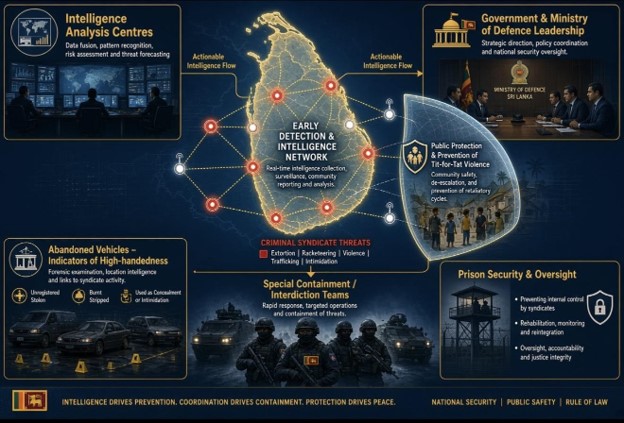
The visible symptoms of this institutional attrition are becoming more lethal. Narcotics trafficking has expanded in scale and sophistication. Stealthy operations and open armed confrontations between drug and criminal syndicates, using firearms and explosives, have become more frequent. Violence inside prison walls has escalated. Illicit gambling networks have grown in reach and confidence.
A more recent and deeply troubling development underscores the urgency. Rivalries among criminal syndicates are intensifying. The latest incident involved the shooting and killing of the mother of a criminal syndicate leader at her home. Although the situation is not yet fully open, the victim’s party is reportedly teaming up with others in preparation for tit-for-tat retaliation. The atmosphere is brewing. Whichever side is able to execute the element of surprise is likely to strike first. Both sides will therefore strive to preserve that surprise factor and position themselves to dominate the other.
The individuals involved display the characteristics of serial killers operating with a “do not care” attitude. Money appears to play a major role. Vehicles, cars, and motorcycles used in these criminal activities are frequently abandoned without regard for their value or ownership. This high-handedness signals both abundant resources and a dangerous sense of impunity.
There is now an acute demand for accurate, timely intelligence on the plans, activities, movements, and whereabouts of these criminals so that they can be apprehended at the earliest possible moment and further loss of life prevented. This is a direct and escalating challenge to law enforcement. It is also a clear illustration of what happens when institutional confidence and risk appetite are allowed to erode: criminal networks fill the space that a hesitant security apparatus leaves vacant.
Diagnosing the Institutional Psychology
The current psychology of the defence, law-enforcement, prison, and intelligence fraternity is the predictable outcome of several converging factors.
The legal foundation for intelligence work remains incomplete. Officers continue to move between identities, police powers, covert roles, inter-agency tasking, and occasional diplomatic functions, without a single coherent statute defining mandate, limits, and protections. When the law is silent, accountability after the fact becomes personal rather than institutional.
The post-Easter investigative processes, while necessary in principle, have been experienced by many practitioners as one-sided. The absence of clear prior rules on escalation thresholds and institutional responsibility has meant that individuals absorb the full weight of systemic shortcomings.
Unresolved questions from earlier periods, communal violence, incomplete learning after 2009, and the handling of residual networks, have left a residue of mutual suspicion within the hierarchy. Trust between services, and between operational levels and senior leadership, has been damaged.
The human cost of service continues to be inadequately recognised. Officers killed, injured, or disappeared in the course of duty, and their families, still depend too often on discretionary decisions rather than clear statutory entitlement. The message received by those still serving is that extraordinary risk is expected while institutional protection remains uncertain.
The Path Back: Positive Action, Changed Approach, and Special Containment Capacity
Restoring confidence and operational will requires more than exhortation. It requires measures that address the psychological dimension carefully while strengthening the professional capacity to manage risk and disrupt escalating criminal threats.
- Enact a comprehensive Intelligence Services Act.
The foundational requirement remains a statute that establishes the principal intelligence agencies and the coordinating role of the Chief of National Intelligence by law; defines powers, limits, and responsibilities; protects officers acting within mandate; safeguards informants and confidential methods; regulates classification and controlled disclosure; and creates credible oversight. Legal clarity is the first defence against both operational hesitation and after-the-fact personalisation of blame.
- Handle the psychological dimension with understanding rather than confrontation.
Leadership must map the open and back-door entities that sustain the current climate. Open narratives should be met with measured, factual institutional communication rather than reactive denial. Back-door influences require patient intelligence work and careful disruption, not public theatre. The goal is to reduce the space in which demoralising narratives and residual adversarial efforts can operate, while rebuilding internal cohesion through consistent process and visible support for officers who act in good faith.
- Re-centre professional risk management and change the operational approach.
Calculated operational risk, taken within lawful parameters, is the core of effective intelligence and security work. This capacity has been eroded. It must be deliberately restored through clear internal doctrine, protected escalation channels, realistic training that treats risk management as a professional skill rather than a personal gamble, and visible backing from the hierarchy when officers act on credible but incomplete information. Law enforcement must shift from predominantly reactive postures to proactive disruption. Without this change in approach, the security apparatus will continue to concede initiative to criminal syndicates.
- Establish specialised containment teams and treat the syndicate continuum as a national-security priority.
The rising violence among criminal networks, the tit-for-tat dynamic now taking shape, the serial-killer mindset of key actors, and the high-handed abandonment of vehicles all demand a more focused response. Dedicated special teams should be formed or strengthened for intelligence-led containment and rapid interdiction of these syndicates. Parallel multi-agency effort is required: deep intelligence penetration of the networks, decisive disruption of supply and finance, and urgent reform of prison security and management. Early apprehension based on accurate knowledge of plans and whereabouts is the most effective way to prevent further loss of life. Tangible progress here would begin to restore both operational confidence and public trust more effectively than any statement of intent.
- Separate accountability from collective demoralisation.
Investigations must reach judicial conclusion. At the same time, the State must draw a clear distinction between genuine culpability and the broader professional community. Public communication from the highest levels should affirm that the vast majority of officers continue to serve with integrity and that the institution itself is being strengthened.
- Build sustained analytical and learning capacity.
An existing coordinating mechanism under the Ministry of Defence should be formally tasked, or a dedicated research and policy capacity created, staffed by experienced practitioners, independent researchers, and legal specialists, with carefully chosen foreign collaboration. Continuous assessment of institutional health, threat evolution, and the effectiveness of reforms is essential if the same patterns of complacency and reactive crisis management are to be avoided.
A Responsibility That Cannot Be Deferred
The present climate of diminished confidence is not inevitable. It is the cumulative result of structural gaps, incomplete institutional learning after 2009, the trauma of Easter Sunday, and an environment that has allowed sustained psychological pressure, open and back-door, to erode the will to serve. The consequences are already visible in the operational domain: weakened deterrence against criminal syndicates, strained prison control, escalating tit-for-tat violence, and a security workforce increasingly reluctant to accept the risks that effective protection requires.
The Government and the leadership of the defence and law-enforcement establishment now face a clear choice. They can allow the present psychology of caution and mutual distrust to harden into permanent institutional culture, or they can take the harder path of legal clarity, careful handling of the psychological dimension, strengthened risk-management capacity, specialised containment teams, and sustained analytical effort.
National security, public peace, and the welfare of citizens depend on the second course. The officers who must still walk the extra mile, still accept calculated risk, and still protect a public whose trust has been shaken, deserve nothing less. The time for decisive, constructive, and positive action is not after the next major killing. It is now. (Eighteen sources)
(This analysis is offered in the interest of national security, institutional reform, and public safety)
Writer – Mahil Dole
Senior Superintendent of Police (Retd.)
Former Head of (Counter Terrorism), State Intelligence Service, Former Director, Police Special Branch and former First Secretary (defense) Sri Lanka Embassy – Thailand.
The writer could be contacted through
mahildole54@gmail.com