True national stability requires a transition this country has postponed for seventeen years: from a military victory to civic reforms that penalise divisive actors and build a unified identity. Last week showed, with unusual clarity, why that transition keeps failing. It was not a failure of slogans. It was a failure of consistency. Democracy, in the narrow sense of ballots and benches, is still standing. What is unhealthy is the use to which those ballots and benches are put. An unhealthy politics does not close a war. It rents it.
Three scenes, one week
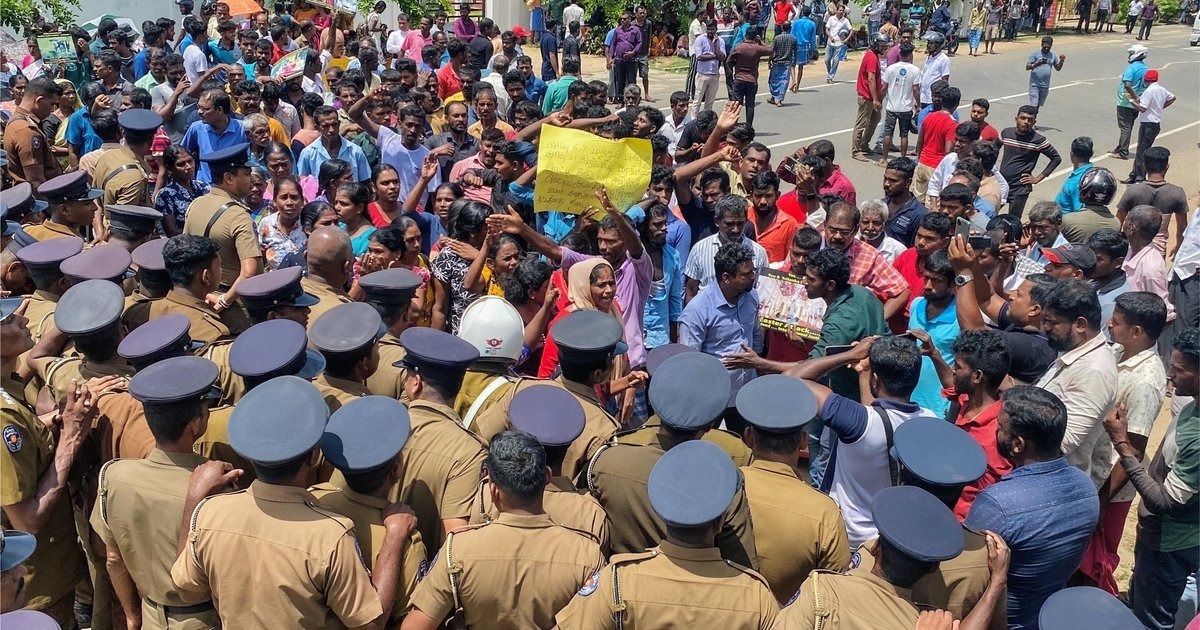
In Chavakachcheri the President told a housing gathering that racism would not be tolerated in any form, against Sinhalese, Tamils or Muslims, in the North, South or East. He named the old kindling: heritage sites and religious places still used to ignite tension. He spoke of houses for the displaced and a stadium for children in Jaffna. Those are the right words for a head of State. A country that meant them would be doing the unglamorous work of peace: making the next generation less useful to anyone who needs a quarrel.
In Anuradhapura, on an SLPP stage, a different performance was under way. Jaffna Member of Parliament Archchuna Ramanathan referred to himself as a “Tiger” and to the elected President as a “fox”. The name of a proscribed organisation was spoken in a town that carries the memory of the sacred-city attack. Party figures who have spent years treating any mention of the LTTE as contamination were reported to have cheered. By Monday a civil-society group styling itself the “Joint Opposition” had taken a complaint to the CID. The Police confirmed receipt. Opposition voices had already raised the alarm on Sunday.
Let the record be exact, because the rumour was not. The complaint now on the CID file is not that the government propagated the LTTE at a government rally. It is that remarks on an SLPP stage, and the cheer that met them, crossed from political insult toward promotion of a banned group. The government, for its part, has said there is no room for LTTE promotion and that remembrance of the dead is another matter. Those are two different files. Mixing them is itself a kind of politics.
A third voice belonged to the same week. Professor Savitri Goonesekere spoke with the clarity that public law, when it is still a discipline and not a campaign colour, can still produce: thoughtful, articulate, addressed to the country rather than to a faction. The speech deserves the praise it has received. The caution it invites is as important as the praise. Worthy slogans,unity, an end to racism, one law for all, are easily hijacked. They are most easily hijacked by those whose own conduct is under scrutiny, and who need the language of virtue more than they need the discipline of it. A speech of that quality raises the standard. It does not lower the duty to watch who picks the slogan up next.
What an unhealthy democracy does
People vote. Governments change. Parliament sits. That is not a failed democracy in the textbook sense. It is also not a healthy one. A healthy system converts a military victory into civic rules that bind the winners as well as the defeated, and that make division expensive. An unhealthy system keeps the war useful. It farms fear. It treats identity as a turnout machine. It issues a guarantee against racism in one district and applauds a banned name in another. That practice is not a lapse of taste. It is a structural reason society remains split.
Duplicity is the method. The same platform that built a career on the defeat of terrorism can, when the arithmetic of a rally requires it, tolerate the self-description of a Tiger. The same voices that demand a ban on LTTE propaganda can discover, the following week, that a rival’s meeting is the real offence. The same guarantee against racism can be issued in the North on one day and left unenforced in the South on the next. Two standards, again — not between Colombo and an overseas capital this time, but between the microphone and the statute book.
The LTTE remains a proscribed organisation. That is law, not a mood. Remembrance of the dead is a human act and must be protected as such. Glorification of the organisation that killed them is not remembrance. A serious State draws that line once, publishes it, and applies it without regard to who is speaking and which party owns the stage. Selective outrage is not law enforcement. It is campaigning.
The same is true of the word “racism”. No President can abolish it by declaring that he will not tolerate it. The declaration is necessary. It is not sufficient. Racism in this country has rarely been only a private vice. It has been a public business model: a way to harvest fear, postpone reform, and keep a constituency enlisted after the guns fell silent. Heritage sites and religious places become kindling because someone lights them. Universities become martyr theatres because someone books the hall. A Member of Parliament can call himself a Tiger on a southern stage because someone calculated that the cheer would be louder than the cost.
Why this divides a people
Division is not produced only by the last war and not only by those who live outside the island. It is produced, week by week, by a politics that cannot address a crowd except through Sinhala, Tamil or Muslim injury. A politics of that kind is not representing a community. It is farming one. The young, who have no memory of the last bunker, inherit the quarrel instead of a country. Serving officers watch the treatment of their predecessors and the theatre of their politicians and draw a rational conclusion about what the country values. Families who lost their own to the LTTE hear “Tiger” cheered and conclude that their dead have been repriced. Families who lost their own to the State hear a pledge against racism and wait to see whether the pledge runs south as well as north.
That is how an interval is mistaken for peace. The guns are silent. The inventory is not. “Tiger” and “traitor”, “racist” and “patriot”, remain stock in trade. So long as those words pay, in applause, in airtime, in a complaint that wounds an opponent, someone will keep them in circulation. Professor Goonesekere’s warning sits exactly there. Leadership means going beyond rhetoric. The law is not written for those who already respect it. It is written for those who violate it. When violation carries no cost, the slogan itself becomes a form of impunity.
What civic reform would actually look like
The work is unglamorous, which is why it is avoided. First, equal enforcement. If the organisation is proscribed, the prohibition travels with the speaker. An SLPP stage in Anuradhapura and a commemoration in the North are not two legal systems. The CID complaint now on the file should be treated as a test of that rule, not as a trophy for whoever lodged it.
Second, an end to ethnic first-identity as an electoral method. A civic identity, Sri Lankan first, faith and language held without being turned into a passport, will not appear by exhortation. It appears when the dividend for division falls and the dividend for competence rises.
Third, a cost for lighting kindling. Heritage sites and religious places are not campaign props. Universities are not martyr calendars. Media that carry a charge must carry the correction. Records that hold an untested allegation must not shadow a working life after the allegation has failed.
Fourth, one standard for those who served the State and those who fought it. Wrongdoers on every side belong in a court, not in a diplomatic weather system and not in a rally chant. Collective punishment of a profession is not accountability. A cheer for a banned name is not unity. A slogan against racism is not a policy until it binds the speaker’s own side.
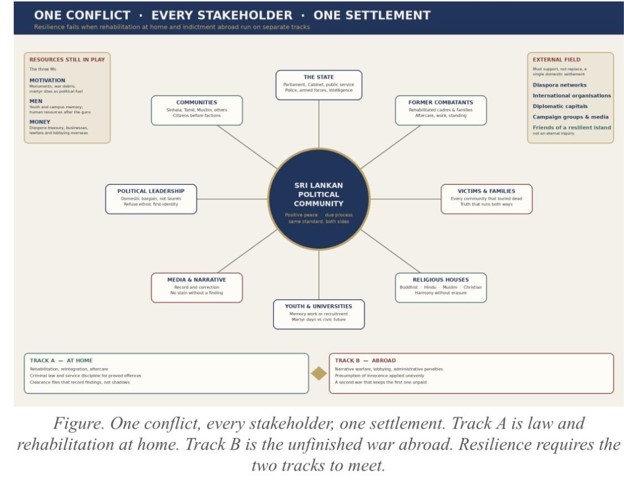
None of this requires a new brand of commission. It requires a State that stops allowing division to be a career. South Africa’s imperfect bargain at least tried to bind both sides inside one process. Colombia wrote one jurisdiction for guerrillas, paramilitaries and State forces. We have preferred two international ledgers and a third, domestic one on which the war is rented out by the evening. Last week’s scenes, a guarantee in Chavakachcheri, a cheer in Anuradhapura, a serious speech that must not be stolen, are not opposites. They are the same unfinished settlement, spoken in three registers.
The President’s sentence should be kept, and then made expensive to break. Professor Goonesekere’s standard should be kept, and then applied to those who clap for it. Racism will not be defeated by a rally, and a proscribed organisation will not be dissolved by a complaint. They will be reduced only when the State, and the parties that live off the State, stop treating the finished war as inventory. True national stability is not the memory of a victory. It is the construction of a civic order that no longer needs that victory to be refought, in Anuradhapura or in Geneva, in order for someone to remain relevant.
The writer is a retired Senior Superintendent of Police who served in intelligence and counter-terrorism. He is the author of Security Beyond Enforcement: Practical Approaches for a Safer Nation. This column is a stand-alone extension of an earlier argument on two standards in one conflict. Views expressed are his own.