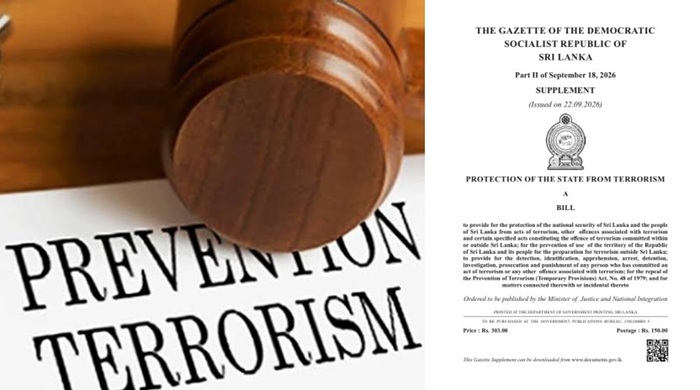
The Government has gazetted a new Protection of the State from Terrorism Bill, proposing to repeal and replace the Prevention of Terrorism (Temporary Provisions) Act, No. 48 of 1979.
The Bill, published in a Gazette Supplement dated September 18 and released on September 22, introduces a new legal framework covering terrorism-related offences, arrests, investigations, detention and prosecution.
According to the proposed legislation, the law is intended to protect national security and the public from terrorist acts committed within or outside Sri Lanka. It also seeks to prevent Sri Lankan territory from being used to prepare or facilitate terrorist activities abroad.
The proposed law would apply to offences committed by Sri Lankan citizens both inside and outside the country, as well as certain acts targeting Sri Lankan citizens, diplomatic missions and State-owned property overseas.
The Bill defines terrorism as the intentional or knowing commission of acts intended to create a state of terror among the public or compel a government or international organisation to act or refrain from acting in pursuit of a political or ideological objective.
Acts covered include causing death or grievous injury, hostage-taking, serious damage to public infrastructure, major environmental harm, cyberattacks against critical systems and offences covered by international anti-terrorism conventions.
A person convicted of an act of terrorism resulting in death could face life imprisonment. Other terrorism-related offences could carry prison sentences of up to 20 years and fines of up to Rs. 20 million.
The Bill would also criminalise attempts, conspiracies and preparations to commit terrorist acts. Individuals involved with proscribed organisations through recruitment, financing, training, logistical support or participation could face up to 15 years in prison and fines of up to Rs. 15 million.
Additional offences include harbouring terrorism suspects, assisting offenders, withholding information about terrorism-related offences and distributing terrorist publications or material intended to encourage terrorism.
At the same time, the proposed legislation contains provisions stating that participation in protests, strikes, trade union activities, advocacy, dissent and humanitarian work would not, by themselves, constitute terrorism offences.
It also provides protections for journalism, academic and scientific research, civil society activities, legal representation, artistic expression, satire, political criticism and peaceful expressions of opinion or dissent, provided such activities do not intentionally incite terrorism.
The Bill sets out procedures governing arrests, searches and investigations. Arrested persons must be informed of the reasons for their arrest and their right to legal representation. Notice of an arrest must also be provided to the suspect’s next of kin and the Human Rights Commission of Sri Lanka.
Generally, suspects would have to be produced before a magistrate within 48 hours of arrest. However, where further detention is considered necessary for an investigation, the Secretary to the relevant ministry could issue a detention order upon an application by the Inspector General of Police or an authorised Deputy Inspector General.
Each detention order could remain in force for up to two months, while the total period of detention could not exceed one year from the date of the initial detention order. Any extension beyond the initial two-month period would require approval from the High Court.
The proposed law also provides for an Independent Review Committee, consisting of a retired Supreme Court or Court of Appeal judge and two other members with expertise in areas including law, human rights, public administration or national security.
The committee would review detention orders and make recommendations on whether they should be upheld, amended or revoked.
Further oversight mechanisms include periodic reviews of detainees’ welfare by magistrates and inspections of approved detention facilities by magistrates and authorised Human Rights Commission officers.
The Bill also provides for medical examinations where there are allegations or suspicions of torture or cruel, inhuman or degrading treatment.
Suspects detained under the proposed legislation would have access to lawyers, relatives and other visitors, subject to conditions established by law. Investigations would also be required to be completed without unnecessary delay.
If enacted by Parliament, the Protection of the State from Terrorism Act would replace the long-standing PTA and establish a new legal framework for addressing terrorism, including offences, investigations, detention, judicial oversight and safeguards for persons suspected of terrorism-related offences.